 Everest Climbing Tours
Tengboche Monastery: History, Mani Rimdu and Visiting on the Trek
Tengboche Monastery stands at 3,867 m (12,687 ft) in the Khumbu and is the largest gompa in the region. This guide covers its founding in 1916, the 1934 earthquake, the 1989 fire and the rebuilding that followed, plus the Mani Rimdu festival, the prayer times, the visitor rules and where the monastery sits on the trail. If you are weighing up Everest climbing tours that pass this way, the monastery is the cultural stop on the routes that include it. The page also lists the treks that reach it and what each of those trips actually includes. The bookable trips are compared on Mount Everest climbing tours.
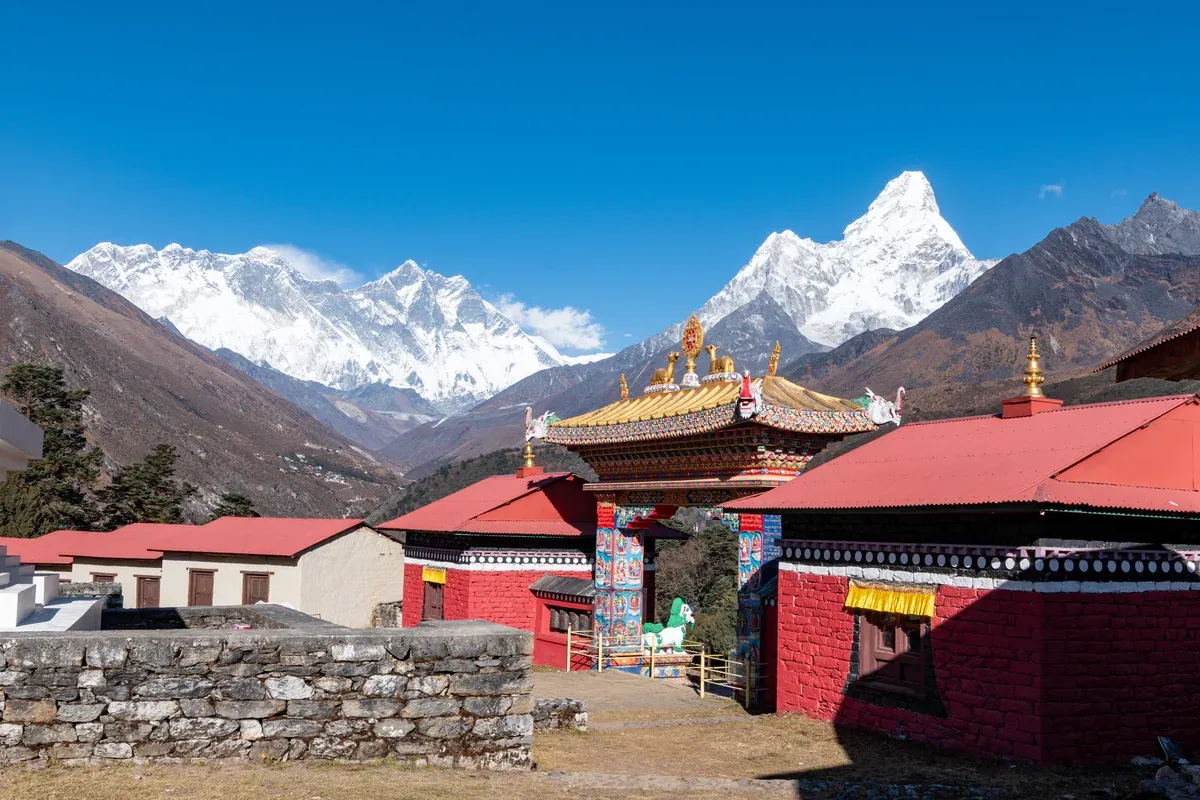
Tengboche Monastery with Everest, Lhotse and Ama Dablam. Photo: Rohit Sharma, CC BY-SA 4.0, via Wikimedia Commons
Quick answer Tengboche Monastery at a glance
Tengboche Monastery sits at 3,867 m (12,687 ft) in the Khumbu and is the largest gompa in the region. Lama Gulu founded it in 1916, with Rongbuk Monastery in Tibet as its mother house. An earthquake destroyed it in 1934 and an electrical fire destroyed it again on 19 January 1989. The rebuilt monastery was consecrated in 1993 after donations from around the world, and about 60 monks live there according to Wikipedia and Nepal Traveller, though Wikipedia's village article counts 50 monks and five families.
Key takeaways
- The Everest Panorama Trek turns around at Tengboche, reaching 3,870 m in 8 days, far below base camp.
- The Everest Base Camp Trek 14 Days passes the monastery on the way up the valley, with flights and permits included for $1,800.
- Read how the monastery fits the wider trail in the guide to the Everest Base Camp trek.
- The site's comparison of Everest climbing tours covers what each listed trip includes and leaves out.
Founded, Destroyed, Rebuilt
Tengboche Monastery has been built three times in just over a century. The dates below come from Wikipedia and Nepal Traveller.
A Timeline of the Monastery
The monastery was built in 1916 by Lama Gulu and was the first celibate Nyingma monastery in the region. Its mother monastery is Rongbuk in Tibet, which sits at about 4,980 m (16,340 ft) and was founded in 1902, so Tengboche belongs to a lineage that is older than the mountaineering era. Nawang Tenzin Zangbu, the Tengboche Rimpoche, was born in 1935 in Namche Bazar, was identified as the reincarnation of Lama Gulu and led the monastery from 1956 for 64 years.
Nepali Times reported his death in 2020, and it also credits him with founding the Sagarmatha Pollution Control Committee in 1991. The table sets out the four events that shaped the building you see today, with the source for each claim.
| Year | Event | Source |
|---|---|---|
| 1916 | Lama Gulu builds the monastery at 3,867 m (12,687 ft) | Wikipedia |
| 1934 | An earthquake destroys the monastery. It is rebuilt under Umze Gelden with a carpenter from Lhasa | Nepal Traveller |
| 19 January 1989 | A fire from an electrical short circuit destroys scriptures, statues, murals and wood carvings | Wikipedia |
| 1993 | The rebuilt monastery is consecrated after worldwide donations | Wikipedia |
The Monastery Today
The 1993 consecration followed donations from around the world. Nepal Traveller names two of the donors as the Sir Edmund Hillary Himalayan Trust and the American Himalayan Heritage Foundation. About 60 monks live at Tengboche according to Wikipedia and Nepal Traveller, though Wikipedia's village article puts the permanent population at only 50 monks and five families, so the count depends on who is counted and when.
The monastery receives about 15,000 visitors a year, rising to about 600 a week in peak season, on the trail between Namche Bazaar and base camp. The village lies where the Dudh Kosi and Imja Khola rivers meet, and the monastery stands above it inside Sagarmatha National Park. Wikipedia gives the elevation as 3,867 m, while Nepali Times puts it at 3,780 m and a Wikipedia infobox at 3,860 m, so printed figures differ by up to about 90 m.
Sources: Wikipedia, Mount Everest, Wikipedia, Sagarmatha National Park
The Mani Rimdu Festival
Mani Rimdu is the festival that fills the monastery courtyard with dancers, and it is the reason many trekkers time their trip for late autumn.
When and What
Wikipedia says Mani Rimdu is held in the tenth month of the Tibetan calendar, which falls roughly in October to November, and lasts nineteen days. The same article's own section on 2022 lists the month differently, so even the sources disagree on the month within the Tibetan calendar. What is agreed is the public part.
NepalHiking says only the final three days are open to visitors, and they are Wong, Chham and Jinsak. Wikipedia gives 8, 9 and 10 November as the 2022 public dates, which shows how the festival moves against the Gregorian calendar from one year to the next. Nepal Traveller describes the content: a sand mandala is built, monks perform masked Cham dances, and blessed red pills are given to devotees.
The festival began at Rongbuk under Ngawang Tenzin Norbu, and it is now held at three sites in the region, Tengboche, Chiwong and Thame, so Tengboche is one home of the tradition rather than the only one. If you want to attend, plan the trip around the public three days, because only those days are open to the public.
Planning Around the Dates
The festival dates follow the Tibetan calendar, so they shift each year and are announced by the monastery rather than fixed on a Gregorian date. No published Mani Rimdu dates for the coming season were found, so check with the monastery or a local operator close to your travel window. Any trip that reaches Tengboche in late October or November has a chance of overlapping the festival, and the Everest Base Camp Trek 14 Days lists Tengboche among its stops.
Expect the entry fee to rise during the festival. NepalHiking says the normal entry fee is about NPR 300 and that it rises to about NPR 500 during Mani Rimdu.
TENGBOCHE MONASTERY: A Spiritual Sanctuary in the Himalayas
The monastery on its ridge and its prayer hall. Third-party video by Mindful Himalaya. This site did not shoot it and has no relationship with the creator.
Visiting on the Trek
Tengboche is a working monastery, so there are rules, times and a fee. Here is what the sources say.
Rules, Prayer Times and Fees
NepalHiking sets out the etiquette: dress with shoulders and knees covered, remove your hat in the prayer hall, and walk clockwise around the monastery. Photography follows a three-level rule. Photos in the courtyard are generally fine, photos inside the prayer hall are stricter, and photography is often not allowed during prayers, so ask before raising a camera.
Daily puja is usually held in the early morning and late afternoon, and Himalayan Vista, citing the Nepal Tourism Board, says monastery tours are conducted in the afternoons, which fits around the morning prayers. The entry fee is about NPR 300, rising to about NPR 500 during Mani Rimdu, according to NepalHiking. That fee is separate from the national park entry you pay lower on the trail, and it is small next to the cost of the treks that bring people here.
The View from the Courtyard
The courtyard view is the reason many trekkers stop and stay. NepalHiking says it takes in Ama Dablam, Everest, Lhotse, Nuptse, Thamserku and Kangtega, six named peaks from one spot. Wikipedia puts Ama Dablam at 6,812 m and says the name is Sherpa for mother's charm box.
Everest itself is 8,848.86 m (29,031.7 ft) by the 2020 joint Nepalese and Chinese survey. No view is guaranteed, because cloud and weather close in fast at 3,867 m, so treat the panorama as a strong chance rather than a promise.
Where Tengboche Sits on the Trail
Magical Nepal puts Namche Bazaar to Tengboche at about 10 km, typically 5 to 6 hours on foot. NepalHiking says the last stretch from Phunki Tenga is a steep climb of about two hours. The monastery is the turning point for short trips.
The Everest Panorama Trek is an 8-day trek that stops at Namche Bazaar and Tengboche Monastery, tops out at 3,870 m and costs $1,225 per person. Longer routes pass through on the way to base camp. The Everest Base Camp Trek 14 Days at $1,800 includes the Kathmandu to Lukla flights and both permits, and the Everest Base Camp 12 Days is a shorter version at $955 that reaches Kala Patthar.
| Trip | Days | Price | Highest point |
|---|---|---|---|
| Everest Panorama Trek | 8 days | $1,225 per person | Tengboche, 3,870 m (12,694 ft) |
| Everest Base Camp Trek 14 Days | 14 days | $1,800 per person | Kala Patthar, 5,555 m |
| Everest Base Camp 12 Days | 12 days | $955 per person | Kala Patthar, 5,545 m |
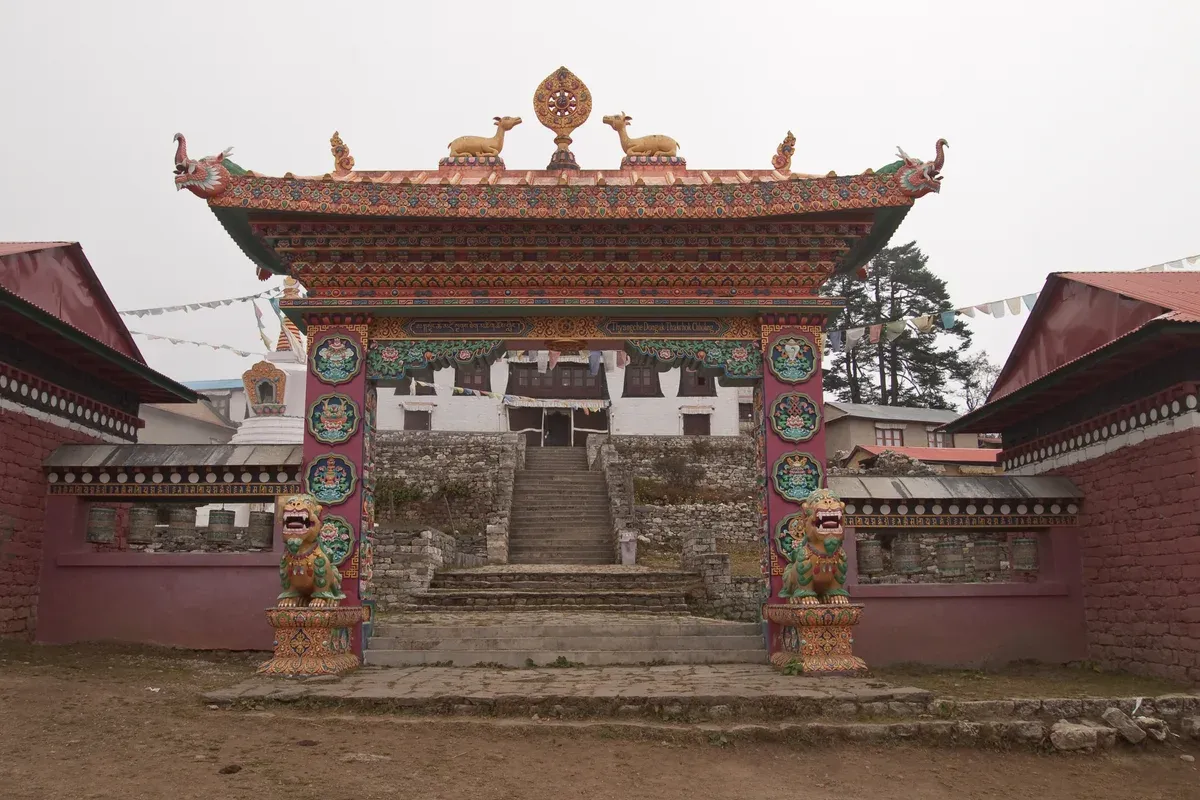
The gate of Tengboche Monastery. Photo: Vyacheslav Argenberg, CC BY 4.0, via Wikimedia Commons
Do and Don't at Tengboche
Do
- Do cover your shoulders and knees, because NepalHiking names covered shoulders and knees as the dress rule for the monastery.
- Do remove your hat inside the prayer hall, because NepalHiking lists hat removal as required there.
- Do walk clockwise around the monastery, because that is the direction NepalHiking says visitors should follow.
- Do visit in the afternoon if you want a guided look, because Himalayan Vista, citing the Nepal Tourism Board, says monastery tours run in the afternoons.
- Do carry about NPR 300 for the entry fee, because NepalHiking lists that as the normal fee, rising to about NPR 500 during Mani Rimdu.
Don't
- Don't photograph during prayers, because NepalHiking says photography is often not allowed during prayers, even when courtyard photos are fine.
- Don't count on walking in during prayers, because NepalHiking says daily puja is usually held in the early morning and late afternoon.
- Don't expect a fixed festival date, because Mani Rimdu follows the Tibetan calendar and its public days shift each year against Gregorian dates.
- Don't treat the mountain view as certain, because weather and cloud at 3,867 m can close the panorama of Everest and Ama Dablam at any hour.
Tengboche Monastery FAQ
Can you see Everest from Tengboche Monastery?
NepalHiking lists Everest in the courtyard view, along with Ama Dablam, Lhotse, Nuptse, Thamserku and Kangtega. Cloud can block it, so no view is promised. Treks built around the panorama, like the Everest Panorama Trek, turn here.
How high is Tengboche Monastery?
Wikipedia gives 3,867 m (12,687 ft), and that is the figure used on this page. Nepali Times says 3,780 m and a Wikipedia infobox says 3,860 m, so sources differ by up to about 90 m. For context, the monastery is far below Everest Base Camp at 5,364 m (17,598 ft), which the Everest Base Camp guide covers.
When is the Mani Rimdu festival?
Wikipedia places it in the tenth month of the Tibetan calendar, roughly October to November, and says it lasts nineteen days. Only the last three public days, Wong, Chham and Jinsak, are open to visitors, and the dates shift each year. The entry fee rises to about NPR 500 during the festival per NepalHiking.
How far is Tengboche from Namche Bazaar?
Magical Nepal puts it at about 10 km and 5 to 6 hours on foot, with a steep final climb of about two hours from Phunki Tenga per NepalHiking. The Namche Bazaar guide covers the acclimatisation stop before it.
Can you stay at Tengboche Monastery for free?
Not stated in the sources read. The record describes about 60 monks at the monastery and a village of 50 monks and five families. The Everest Panorama Trek lists an overnight at Tengboche, though the hotel type is not stated.
What treks include Tengboche Monastery?
The 8-day Everest Panorama Trek turns around there, while the Everest Base Camp Trek 14 Days crosses it on the way up.