 Everest Climbing Tours
The Everest Base Camp Trek
The Everest Base Camp trek is a walk through the Khumbu valley to the foot of the highest mountain on earth. This page covers the walk itself: how many days it takes, the distance and daily stages, how hard it is, what a teahouse night costs, guide and porter wages, permits and the best months. It does not cover base camp as a place, which you can read about on the Everest Base Camp page. Figures come from named independent sources, and where sources disagree both sides are given. The bookable trips are compared on all Everest climbing tours.
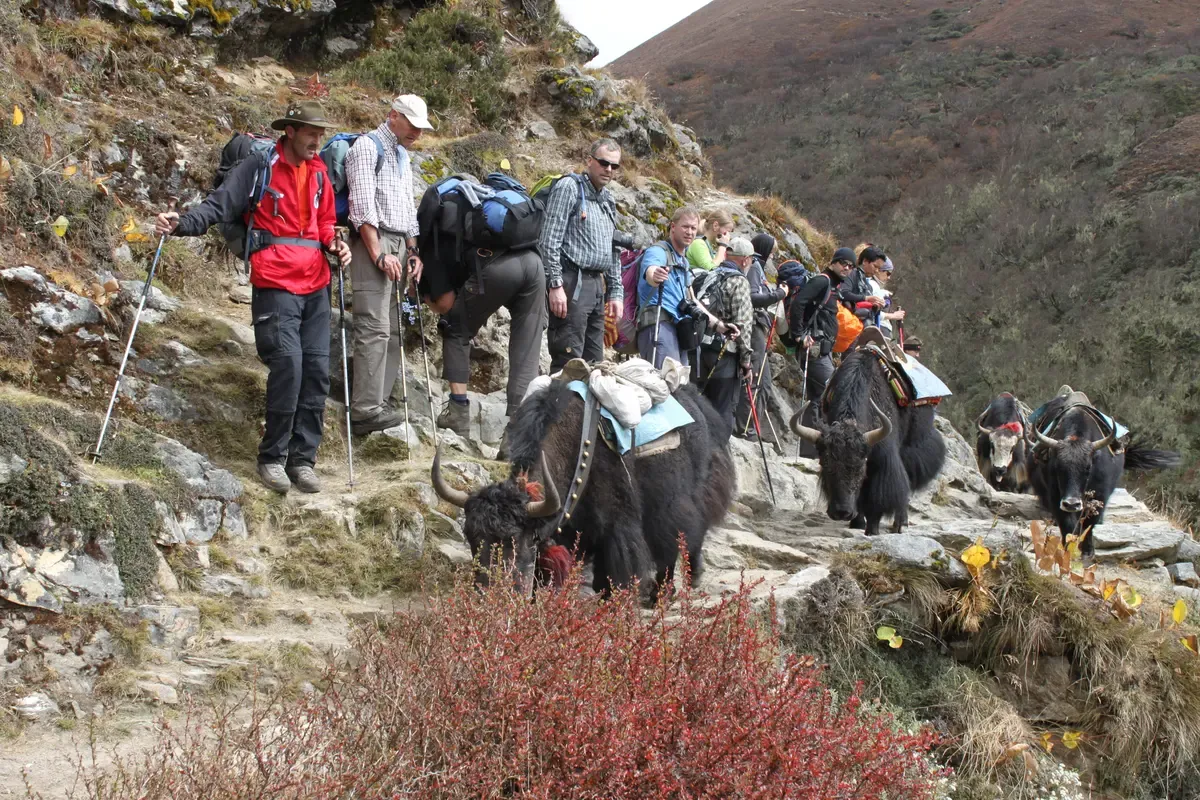
Trekkers and yaks on the trail near Orsho. Photo: Superikonoskop, CC BY-SA 3.0, via Wikimedia Commons
Quick answer The trek in numbers
The Everest Base Camp trek is a round trip of about 130 km (82 miles) from Lukla, and most trekkers take 12 to 18 days including acclimatisation. Base camp sits at 5,364 m (17,598 ft) and the highest point on most routes is Kala Patthar at 5,545 m (18,192 ft).
Key takeaways
- The standard itinerary runs Lukla, Phakding, Namche Bazaar, Tengboche, Dingboche, Lobuche and Gorak Shep, with rest days at Namche and Dingboche. See the trek day by day.
- A guided 14-day option with Lukla flights and permits is Everest Base Camp Trek 14 Days at $1,800 per person.
- Teahouse rooms run $5 to $10, meals $7 to $12 and a hot shower $4 to $6 per Best Heritage Tour. Full costs are in what the trek costs.
The Trek Day by Day
Every Everest Base Camp trek starts with the flight into Lukla at 2,846 m (9,337 ft), which has its own page at Lukla airport. The stages below follow The World Travel Guy's 13-day itinerary from Kathmandu, with heights cross-checked against Wikipedia and Himalayan Vista Trekking.
Standard Itinerary, Lukla to Base Camp and Back
The table shows a standard 13-day plan of the kind The World Travel Guy describes, flying from Kathmandu to Lukla and walking up the Dudh Kosi valley. Heights are from Himalayan Vista Trekking and Wikipedia. Some figures differ between sources, and both are shown where that happens, for example Dingboche is given as 4,410 m by the Dingboche article and Himalayan Vista Trekking and as 4,260 m (13,980 ft) by the Everest Base Camp article. Camping is not allowed at base camp on trekking permits, so trekkers sleep at Gorak Shep, the last village with accommodation.
Days 10 to 13 retrace the same villages downhill to Lukla and fly back to Kathmandu. A helicopter return can cut three or four days from the walk, per Ian Taylor Trekking, and if you want that built in, EBC Trek with Helicopter Return does the trek in 12 days and flies out from Gorakshep by helicopter.
| Day | Route | Sleep at | Height |
|---|---|---|---|
| 1 | Kathmandu flight to Lukla, walk to Phakding | Phakding | not stated in the sources used |
| 2 | Phakding to Namche Bazaar | Namche Bazaar | 3,440 m (11,290 ft) |
| 3 | Acclimatisation day, hike to Syangboche, about 3 hours per G Adventures | Namche Bazaar | Syangboche at 3,750 to 3,860 m depending on source |
| 4 | Namche to Tengboche, 5 to 6 hours per G Adventures | Tengboche | 3,867 m (12,687 ft) |
| 5 | Tengboche to Dingboche | Dingboche | 4,410 m (14,470 ft) or 4,260 m (13,980 ft), sources conflict |
| 6 | Acclimatisation day in Dingboche | Dingboche | as day 5 |
| 7 | Dingboche to Lobuche, about 5 hours per G Adventures | Lobuche | 4,940 m (16,210 ft) |
| 8 | Lobuche to Gorak Shep, then Everest Base Camp, 1.5 to 2.5 hours one way | Gorak Shep | 5,164 m (16,942 ft), base camp 5,364 m (17,598 ft) |
| 9 | Kala Patthar climb, 1.5 to 2 hours up, then descend | Not stated in the sources used | Kala Patthar 5,545 to 5,550 m (18,192 to 18,209 ft) |
The Two Acclimatisation Days and Why They Sit at Namche and Dingboche
Standard itineraries include two acclimatisation days, one in Namche Bazaar at 3,440 m (11,290 ft) and one in Dingboche, per Ian Taylor Trekking. The logic is a sleeping-height gain of about 300 to 500 m per day above 3,000 m, which Himalayan Hero advises, and Wikipedia puts the ceiling at 300 m (1,000 ft) of daily gain above 3,000 m. Namche at 3,440 m is the first rest stop and Dingboche sits above 4,000 m.
Skipping the rest days can reach base camp in 9 to 10 days but greatly increases altitude sickness risk, per Ian Taylor Trekking. Altitude sickness typically occurs only above 2,500 m and symptoms often show within ten hours of ascent, per Wikipedia. HACE needs immediate descent, per Himalayan Hero, and the Himalayan Rescue Association runs an aid post at Pheriche staffed by volunteer doctors twice yearly in trekking season.
Namche Bazaar itself is covered on the Namche Bazaar page. Ian Taylor Trekking argues that even two rest days are not enough and its own itineraries carry three nights in Namche, so more time is a reasonable choice if your schedule allows it.
Sources: The World Travel Guy, G Adventures, Wikipedia, Himalayan Vista Trekking
How Hard It Is and How to Train
The Everest Base Camp trek needs no ropes and no climbing skill. What makes it hard is volume, altitude and time away from comfort.
Distance, Hours and the Real Difficulty
The round trip from Lukla including Kala Patthar is about 82 miles (132 km) per Ian Taylor Trekking, while The World Travel Guy puts it at about 130 km. The cumulative gain is about 18,324 ft (5,585 m) uphill and 15,853 ft (4,832 m) downhill per Ian Taylor Trekking. Daily walking stages run roughly 5 to 6 hours, for example G Adventures walks Namche to Tengboche in 5 to 6 hours and Dingboche to Lobuche in about 5 hours.
Altitude is the real difficulty. You sleep at 4,940 m (16,210 ft) in Lobuche and 5,164 m (16,942 ft) in Gorak Shep. The World Travel Guy is itself inconsistent, calling the trek not super difficult in one place and a pretty difficult trek in another, and notes people in their 70s and pre-teens have completed it, so a normal healthy person can walk it. Google's questions ask whether a beginner can trek Everest Base Camp. The honest answer is that no technical skill is needed but the pace, the 12 to 18 days and the sleeping heights punish anyone who rushes. Kala Patthar at 5,545 m (18,192 ft) is the highest point of the standard route and is covered on the Kala Patthar page.
How to Train
The published sources carries no formal training plan for this trek, so this is what the sources support. You need to walk 5 to 6 hours a day on back-to-back days with a loaded daypack, since the trek repeats that pattern for about two weeks. Cumulative gain of about 5,585 m uphill over the round trip means steady uphill walking, not speed.
Build long weekend walks before you go and practise on consecutive days, because fatigue accumulates the same way it does on the trail. If you want a higher objective after the trek, Island Peak and EBC Climb adds an Island Peak summit attempt on top of the walk, listed at 6,189 m (20,305 ft) and given as 6,165 m (20,226 ft) by Wikipedia. For the acclimatisation side, Himalayan Hero recommends one acclimatisation day for roughly every 1,000 m gained and drinking 3 to 4 litres of water daily.
Never ascend with worsening symptoms, and Wikipedia lists acetazolamide at 125 mg twice daily started about 24 hours before ascent as a prevention option to discuss with a doctor.
The Complete Everest Base Camp Trek: 12 Days, 130km, 5,380m
The whole trek from Lukla to base camp, stage by stage. Third-party video by What Doesn't Suck?. This site did not shoot it and has no relationship with the creator.
What the Trek Costs on the Trail
A budget Everest Base Camp trek has four parts: permits, the Lukla flights, daily teahouse costs and staff wages with tips. The table gathers the figures from named independent sources, and where two sources disagree both are printed.
Permits, Teahouses, Wages and Tips
The Sagarmatha National Park entry permit is NPR 3,000 for foreigners and NPR 1,500 for SAARC nationals, and most sources list it with no tax added, though The Himalayan Times has described Rs 3,000 plus 13% tax for non-SAARC foreigners. The Khumbu Pasang Lhamu Rural Municipality permit is NPR 2,000 per Hop Nepal and the Kathmandu Post, and NPR 3,000 since 2026 per Everest Trekking Routes. The TIMS card is no longer required in the Everest region per Hop Nepal, and Everest Trekking Routes says the rural municipality permit replaced it for tracking trekkers. The Longest Way Home rounds the whole permit set to $60 total.
On the trail, credit cards are not accepted, ATMs exist only in Lukla and Namche and are unreliable, so carry enough rupees from Kathmandu per The World Travel Guy, who spent about NPR 2,400 (about $20) per day and never more than $25 in a day. Honeyguide suggests tipping 15% of wages or more for guides and porters. The round-trip cost for an average trek is $1,677 and a no-porter trek $1,513 per The Longest Way Home.
| Item | Cost | Source |
|---|---|---|
| Sagarmatha National Park permit | NPR 3,000 (foreigners), NPR 1,500 (SAARC) | Everest Trekking Routes |
| Khumbu Pasang Lhamu Rural Municipality permit | NPR 2,000 or NPR 3,000 since 2026, sources conflict | Hop Nepal and Kathmandu Post vs Everest Trekking Routes |
| TIMS card | No longer required in the Everest region | Hop Nepal, Everest Trekking Routes |
| Teahouse twin room | $5 to $10 per night | Best Heritage Tour |
| Meals | $7 to $12 each | Best Heritage Tour |
| Hot shower | $4 to $6 | Best Heritage Tour |
| Charging a device | $3 to $7 | Best Heritage Tour |
| Wi-Fi card | $20 to $30 | Best Heritage Tour |
| Guide wage | $20 to $40 per day (Wind Horse) vs $25 to $100 plus $30 insurance (Honeyguide) | Wind Horse Tours and Honeyguide |
| Porter wage | $15 to $25 per day (Wind Horse) vs $18 per day (Honeyguide) | Wind Horse Tours and Honeyguide |
| Tips | 15% of wages or more | Honeyguide |
| Lukla flight | $215 each way (The Longest Way Home) vs $150 one way (Himalayan Wonders) | Both sides given |
| Whole trek, round trip | $1,677 average trek, $1,513 without porter | The Longest Way Home |
Bookable Treks and What Their Prices Cover
Guided trips trade money for logistics. Three catalog treks on this site are Everest Base Camp 12 Days at $955 per person, which includes return Kathmandu to Lukla flights and permits, Everest Base Camp Trek Lodge to Lodge at $1,475 per person, which includes flights via Ramechhap, permits and full board and needs at least 2 people per booking, and Everest Base Camp Trek 14 Days at $1,800 per person, which includes Lukla flights with airport departure tax, the national park permit and the Pasang Lhamu fee, and charges a $250 surcharge in Nepal if no group or room share is available. The pick between them depends on if you want the shortest price, full board or the largest review base.
A trek package does not remove the altitude: all of these still sleep high and still depend on the same acclimatisation rules.
Sources: Everest Trekking Routes, Best Heritage Tour, Honeyguide, Wind Horse Tours, The Longest Way Home
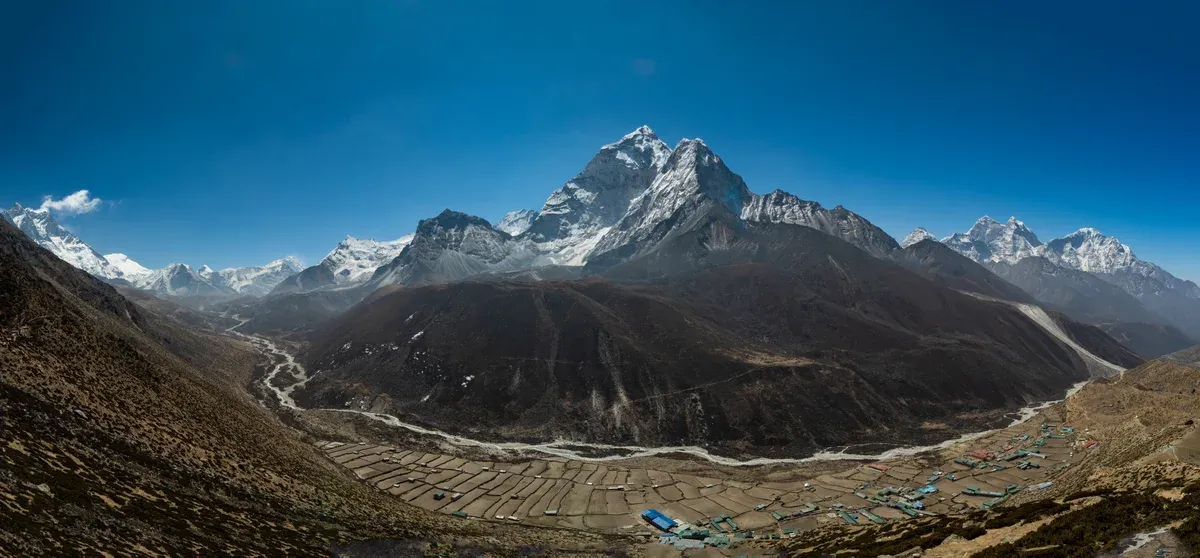
Dingboche at 4,440 m by the photographer's caption, with the Mahalangur Himal behind. Photo: Nirojsedhai, CC BY-SA 4.0, via Wikimedia Commons
Best Months and the Lukla Flight
Season decides both the walking and the flying. The trail conditions and the Lukla reliability move together.
Spring and Autumn, and What Winter Costs You
The Everest region has a spring trekking season of March to May and an autumn season of September to November, per Kandoo Adventures. Monsoon runs June to August with most of Nepal's annual rain, and December to February is the off-season when high-pass treks close. Nights at base camp are cold in every month: Kandoo Adventures lists -17C in March, -12C in April, -8C in May, -9C in October and -12C in November, while Everest Trekking Routes lists -15C in March, -10C in April, -5C in May, -12C in October, -18C in November and -25C from December to February.
The World Travel Guy puts November to February night lows as low as -30C. Teahouse rooms have little or no heating, and Best Heritage Tour gives room temperatures of -5 to 0C at Namche and -18 to -10C at Gorak Shep, with blankets provided. Rooms fill fast in October and November, and solo trekkers may end up sleeping on a bench in the dining hall, per Best Heritage Tour.
Tibet Travel also names April to May and September to October as the best window for the base camp area.
Lukla Delays and the Spare Day
Flights to Tenzing-Hillary Airport run on a 527 m (1,729 ft) runway with an 11.7% gradient, and strong southwest winds usually close it from mid to late morning, so flights are scheduled early. In peak spring and autumn all flights operate from Manthali in Ramechhap, which is 130 to 140 km from Kathmandu and 4 to 5 hours by road per The Bucket List Company, or about 5 hours per Himalayan Wonders, and guests usually leave the Kathmandu hotel around 2 or 3 am. Everest Trekking Routes says October has the best reliability, with about 1 in 10 departures delayed more than 2 hours, and monsoon cancellation rates exceed 60%.
Wikipedia says visibility closes Lukla about 50% of the time in the monsoon. G Adventures suggests keeping about USD 500 one way available for a helicopter if flights cancel. Build spare days into your schedule, because a missed Lukla flight can cost you the whole itinerary.
The flight itself is covered on the Lukla airport page.
Practical Tips
Five things worth doing and four to avoid, each with the reason behind it.
Do
- Do carry enough rupees from Kathmandu, because credit cards are not accepted on the trek and the only ATMs, in Lukla and Namche, are unreliable per The World Travel Guy.
- Do book the two acclimatisation days into your plan, because skipping them can cut the trek to 9 or 10 days but greatly increases altitude sickness risk per Ian Taylor Trekking.
- Do pack a down jacket first, plus fleece, beanie, gloves, merino socks, headlamp, a 1-litre water bottle, sunblock, sunglasses and a big power bank, which The World Travel Guy names as the key items.
- Do drink 3 to 4 litres of water daily and never ascend with worsening symptoms, per Himalayan Hero.
- Do add spare days around your Lukla flights, because October delays hit about 1 in 10 departures and monsoon cancellations exceed 60% per Everest Trekking Routes.
Don't
- Don't plan to sleep at base camp, because camping is not allowed there on trekking permits and trekkers overnight at Gorak Shep per Wikipedia.
- Don't expect a hot shower above 4,000 m, because showers become bucket showers and most trekkers stop washing above that height per Best Heritage Tour.
- Don't budget on the room rate alone, because eating in another lodge may triple the room price and wifi, charging and showers are all extra per Best Heritage Tour.
- Don't set out with worsening altitude symptoms, because HACE needs immediate descent per Himalayan Hero and the trail only goes higher.
Frequently Asked Questions
How long is the Everest Base Camp trek?
The round trip from Lukla including Kala Patthar is about 82 miles (132 km) per Ian Taylor Trekking, and most trekkers spend 12 to 18 days on the round trip including acclimatisation. Walking from Jiri instead of flying adds about 1 week per The World Travel Guy. The stages are listed in the trek day by day section above.
How hard is it to trek to Everest Base Camp?
No technical skill is needed, but you walk 5 to 6 hours a day, for example Namche to Tengboche takes 5 to 6 hours per G Adventures, and you sleep as high as 5,164 m (16,942 ft) at Gorak Shep. Altitude is the real difficulty. The acclimatisation plan is set out in how hard it is and how to train.
How much does it cost to trek to Everest Base Camp?
The Longest Way Home puts the round-trip cost at $1,677 for an average trek and $1,513 without a porter. The same source lists permits at about $60 and the Lukla flights at $430 return. Daily teahouse costs are itemised in what the trek costs on the trail.
Do I need a guide for the Everest Base Camp trek?
From April 1, 2023 Nepal's national rule required foreign trekkers in TIMS-covered areas to hire a licensed guide, but the Solukhumbu region rejected the ruling and says guides are not mandatory in the Everest region per The Longest Way Home. Guide wages are in the costs section, and a guided trip such as Everest Base Camp Trek 14 Days removes the question.
What permits do I need for the trek?
Two: the Sagarmatha National Park entry permit at NPR 3,000 and the Khumbu Pasang Lhamu Rural Municipality permit, which sources list at NPR 2,000 or NPR 3,000. The TIMS card is no longer required in the Everest region per Hop Nepal. The full breakdown sits in the permits table.
When is the best time to do the Everest Base Camp trek?
March to May and September to November are the trekking seasons, per Kandoo Adventures, with base camp nights between -5C and -18C depending on month and source. Monsoon from June to August cancels more than 60% of Lukla flights per Everest Trekking Routes. The month-by-month detail is in best months and the Lukla flight.