 Everest Climbing Tours
Climbing Mount Everest: Routes, Time, Cost and Who Gets to Try
Climbing Mount Everest means six to eight weeks on the mountain, two possible routes, one death zone and a price that starts well before the first step uphill. This guide covers the southeast ridge in Nepal and the north ridge in Tibet, the camps and rotations, how long an expedition takes and why, the death in the statistics, the Hillary Step, and the experience operators ask for before they take you. If you want the full money breakdown, the page on how much it costs to climb Everest handles it in detail. The bookable trips are compared on Everest climbing tours.
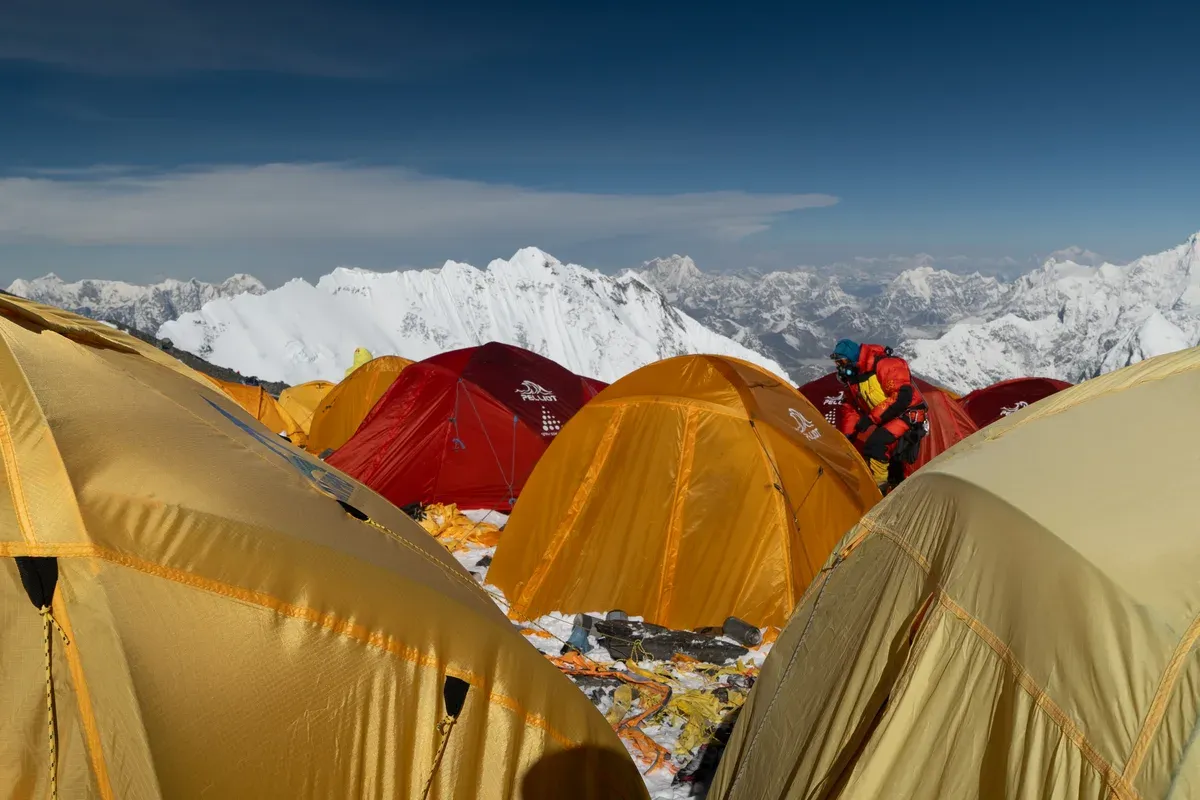
Camp IV on the South Col, about 7,900 m by the photographer's caption. Photo: AngeliSherpa, CC BY-SA 4.0, via Wikimedia Commons
Quick answer Climbing Mount Everest at a glance
Climbing Mount Everest takes about 60 days on a standard guided expedition: 7 to 12 days trekking to base camp, four to six weeks of acclimatization rotations, and a summit push of 4 to 7 days. Two routes are in use, the Southeast Ridge from Nepal and the North Ridge from Tibet, and Everest stands 8,848.86 m (29,031.7 ft) high. Most climbers use bottled oxygen above 8,000 m, where the death zone begins.
Key takeaways
- The full south-side expedition on the Everest Expedition Nepal listing runs 60 days at $42,000 per person with permits, oxygen and flights from Kathmandu to Lukla included.
- New to high altitude, build up first on Island Peak Climbing at 6,189 m (20,305 ft) or Mera Peak Climbing, the standard step-up peaks below Everest.
- Compare every option, from treks to the full climb, on the Everest climbing tours homepage or jump to the full expedition section.
The Two Main Routes
Everest can be climbed from Nepal or Tibet. Wikipedia calls the Southeast Ridge from Nepal the technically easier and more frequently used route, and the North Ridge from Tibet the other main line.
South Side Versus North Side
The table sets the two routes side by side using figures from Wikipedia, Alan Arnette and Tibet Travel. Both start above 5,000 m (16,404 ft), which Wikipedia gives as the usual starting height for base camps. Heights differ between sources and both figures are given.
South side base camp is 5,364 m (17,598 ft) on the Nepal side per Wikipedia, while Alan Arnette and Tibet Travel put it at 5,334 m (17,500 ft). North base camp is given as 5,200 m in one source and about 5,182 m (17,000 ft) by Alan Arnette, on windy gravel near Rongbuk Monastery, which sits at about 4,980 m (16,340 ft) and was founded in 1902.
| Feature | Southeast Ridge (Nepal) | North Col (Tibet) |
|---|---|---|
| First ascent | 29 May 1953, Edmund Hillary and Tenzing Norgay | 25 May 1960, Chinese team of Wang Fuzhou, Gonpo and Qu Yinhua |
| Base camp | 5,364 m (17,598 ft) per Wikipedia, 5,334 m (17,500 ft) per Alan Arnette | 5,200 m per one source, about 5,182 m (17,000 ft) per Alan Arnette |
| High camps | Camp 1 5,943 m, Camp 2 6,400 m, Camp 3 7,162 m, South Col about 7,986 m to 8,016 m (Arnette and Alpine Ascents), Tibet Travel gives Camp 2 at 6,500 m, Camp 3 at 7,470 m and Camp 4 at 7,920 m | Tibet Travel lists Camp 2 at 6,000 m, Camp 3 at 6,500 m, Camp 4 at 7,010 m, Camp 5 at 7,775 m and Camp 6 at 8,230 m |
| Key hazards | Khumbu Icefall at 5,486 m (17,999 ft), a moving icefall crossed on ladders and fixed ropes, plus the Hillary Step near the top | No Icefall. Alan Arnette reports no helicopter rescue at any point on this side |
Why Most Climbers Take the South Side
Tibet Travel says about two-thirds of Everest climbers go via Nepal and the rest via Tibet, and calls the north side the more challenging route. Two practical reasons explain the split. First, helicopter rescue exists on the Nepal side from as high as Camp 3 according to Alan Arnette, with private evacuations priced at $5,000 to $20,000, while Tibet has no helicopter rescue or evacuation, which he says may begin or 2028.
Second, Nepal issues permits without a cap while China caps Tibet-side permits at 300 a year for hired and member teams, a cap not reached since 2007. In 2025 the south side field was 303 members supported by 428 Sherpas, against 68 members supported by 52 Sherpas on the north. The trade-off is the Khumbu Icefall, 2,000 ft of moving ice that can shift as much as 1 m (3 ft) a day along its edges, though Alan Arnette notes more climbers die on other sections of Everest than in the Icefall.
Sources: Wikipedia, Alan Arnette, Tibet Travel
How Long It Takes: Rotations and the Summit Push
How long does it take to climb Everest? The honest answer is weeks, and the reason is acclimatization, not fitness.
Six to Eight Weeks End to End
Wikipedia says traditional Everest expeditions last 50 to 60 days, and altitude tents can cut that to 30 to 35 days. Alan Arnette puts traditional expeditions at six to eight weeks and speed climbs at two to four weeks, often with a hypoxic tent used beforehand. Alpine Ascents schedules its standard South Col expedition at 51 days plus weather days up to day 55, and its Speed Ascent at 39 days plus weather days up to day 43. Furtenbach Adventures says hypoxic pre-acclimatization at home takes 6 to 8 weeks and cuts its Flash expedition to three weeks, with a helicopter flight to base camp. Adventure Consultants runs a 30-day fast-track itinerary that helicopters to Pheriche at 4,270 m and flies back from base camp.
The average time to summit has also shortened over the years. Alan Arnette puts it at 28 days, against 33 days in 2019, 36 days in 2010 and 48 days in 2005.
The Camps on the South Side
On the Nepal side the camps climb in steps, and sources disagree on exact heights, so both are given. Alan Arnette lists base camp at 5,334 m (17,500 ft), Camp 1 at 5,943 m, Camp 2 at 6,400 m, Camp 3 at 7,162 m and the South Col at about 7,986 m (26,201 ft). Alpine Ascents lists Camp IV (South Col) at 8,016 m (26,300 ft). Tibet Travel gives the Nepal-side Camp 2 at 6,500 m, Camp 3 at 7,470 m and Camp 4 at 7,920 m.
The first obstacle is the Khumbu Icefall at 5,486 m (17,999 ft), crossed on rope and ladder networks installed by professional guides, with most climbers crossing before sunrise. An experienced acclimatized climber crosses it in a few hours, an inexperienced one in 10 to 12 hours. From there the standard timings are 3 to 6 hours to Camp 1, 2 to 3 hours to Camp 2 and 3 to 6 hours to Camp 3.
Rotations Before the Push
Climbers do not go straight up. Furtenbach Adventures describes 7 to 12 days trekking from Lukla at 2,846 m (9,337 ft) to Everest Base Camp at 5,364 m, then 4 to 6 weeks of acclimatization rotations and a summit push of 4 to 7 days. The rotations follow the climb high, sleep low principle, going up to sleep at altitude and coming back down to recover.
Alpine Ascents runs one rotation through Camp 1, Camp 2 and a touch of Camp 3 before returning to base camp, and includes a Lobuche East climb at 6,119 m (20,075 ft) before the rotations begin. Alpine Ascents uses supplemental oxygen above Camp 2 to help climbers reach high camp.
The Summit Window and the Death Zone
The summit push is timed to a weather window. In 2026 the first Sherpa summit came on 13 May and about 80% of that season's summits fell between 17 and 26 May, with a single-day record of 274 on 20 May. Alpine Ascents reaches Camp 4 on the South Col on day 46, holds the summit window on days 47 and 48, and is back at base camp on day 50.
The death zone is generally considered to begin at 8,000 m, where air pressure is less than 356 millibars against 1013.25 millibars at sea level. At 8,849 m the partial pressure of oxygen is less than a third of its sea-level value. Climbers usually begin bottled oxygen at the South Col, and summit attempts typically start before midnight from the Balcony region. Wikipedia says about 95% of climbers who reach the summit use bottled oxygen, that the death rate is double for those who go without it, and that bottled oxygen adds roughly US$3,000 to costs. Adventure Consultants lists a 1:1 Sherpa-to-climber ratio on summit day and high-flow oxygen at 1 litre per minute for sleeping and 4 litres per minute for climbing. Only 232 summits of Everest have ever been made without oxygen. Reinhold Messner and Peter Habeler made the first on 8 May 1978, and Messner climbed it alone and oxygen-less during the monsoon on 20 August 1980.
The Final Push
The round trip from the South Col typically takes 9 to 18 hours. Furtenbach Adventures and Tibet Travel both put the final push from Camp 4 at 10 to 12 hours. The Balcony sits at 8,382 m (27,500 ft) and the South Summit at 8,690 m (28,500 ft) per Alan Arnette.
From the Hillary Step the summit is about an hour further. Climbers spend less than half an hour at the top, per Wikipedia, and the descent that follows carries the highest incident rate on the Southeast Ridge route according to Alan Arnette. Spring is the main Everest season, and Wikipedia regards autumn as more dangerous because of new snow.
Sources: Alan Arnette, Alpine Ascents, Furtenbach Adventures
All The Ways Mt. Everest Can Kill You
The hazards on the climb, from the icefall to the death zone. Third-party video by WIRED. This site did not shoot it and has no relationship with the creator.
Deaths, Crowds and the Hillary Step
How hard is climbing Everest, in the blunt sense of the risk? The Himalayan Database has counted every season, and the numbers say safer than the past but not safe.
How Many People Have Died Climbing Everest
The Himalayan Database, as reported by Alan Arnette, totals 13,737 summits and 339 deaths on Everest, of which 207 were Westerners and 132 were Sherpas. Hop Nepal quotes the same database at 344 deaths, five of them, and 13,550 summits, so the totals differ slightly by source. Wikipedia counts 340 deaths, with over 200 bodies remaining on the mountain.
By side, Nepal totals are 9,876 summits and 229 deaths, and Tibet totals are 3,861 summits and 110 deaths. Alan Arnette's route page counts 195 deaths on the Nepal side and 74 on the Tibet side, so the split depends on the page. The death rate was 1.4% of summits from 2000 to 2025, against 14.5% from 1922 to 1999. Recent seasons: 18 deaths in 2023, the modern-era record, 8 in 2024 (Lacrux says nine), and 5 in both 2025 and 2026.
What Kills Climbers
The causes are documented. Avalanches, the blizzard of 1996, crowding and delays, and hypoxia all appear in Wikipedia's list, and the Khumbu Icefall killed 16 Nepalese climbers in an avalanche on 18 April 2014. A 2008 BMJ study led by Paul Firth counted 212 deaths from 1921 to 2006, with 192 above base camp, and found most deaths occur during descents from the summit, with climbers dying at six times the rate of Sherpas during descent.
Hop Nepal says 76.5% of climber fatalities from 2007 to 2024 occurred on summit day. Alan Arnette agrees the descent has the highest incident rate on the Southeast Ridge. In 2025 five deaths fell in April and May, including a climber descending the Hillary Step.
In 2025 success rates varied sharply by side: members succeeded at 63% (303 of 481) on the Nepal side and 86% (68 of 79) on the Tibet side.
Crowds on the Fixed Lines
Nepal has no cap on permits, and the counts keep rising. Spring 2019 saw a record number of climbers summit (891 per Wikipedia, 877 per the Himalayan Database) and images of hundreds queuing drew global criticism. Spring 2025 brought 851 summits, 731 from Nepal and 120 from Tibet, the third busiest season behind 2019's 877.
Spring 2026 set a new record: Alan Arnette reports 495 permits issued, a record held by clients from 56 countries, and 1,008 Nepal-side summits with a single-day record of 274. China caps its side at 300 permits a year. Crowding matters because Wikipedia lists crowding and delays among the causes of death.
The Hillary Step, Before and Now
The Hillary Step was a 40-foot (12 m) rock face at 8,790 m (28,839 ft), about 30 m below the summit, named for Edmund Hillary, who described it in 1953 as about 12 m of climbing. Alan Arnette puts it at 28,740 ft, roughly 50 ft of rock climbed on fixed ropes. Wikipedia says it was destroyed by the April 2015 Nepal earthquake, with climbers reporting in May 2017 that it was no more, though other climbers said it had only partly changed.
What is documented since: in 2024 a cornice at the Hillary Step collapsed and killed two people. Sources disagree on whether the step is gone or only changed, so treat any description of the final ridge with care.
Sources: Alan Arnette, Himalayan Database figures via Alan Arnette, ScienceDaily on the BMJ study
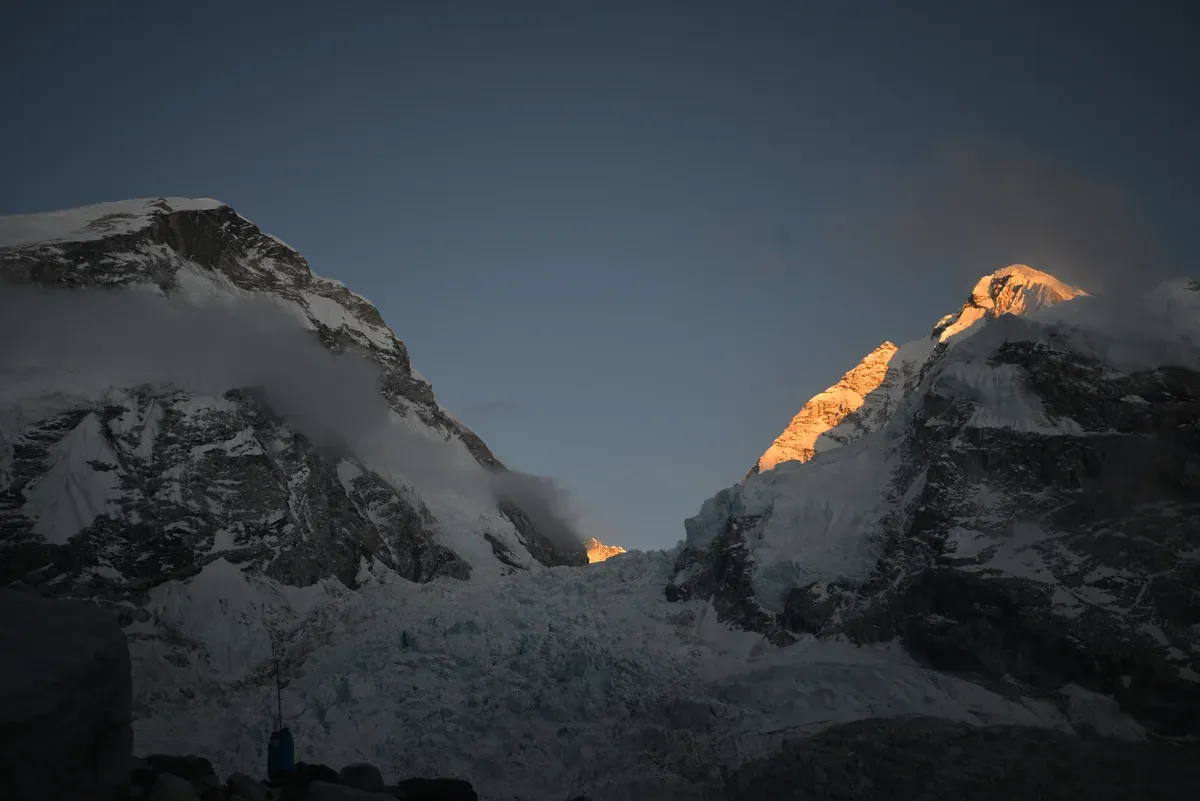
The Khumbu Icefall from base camp, with the west shoulder of Everest, Lhotse and Nuptse above. Photo: Thaneswar Guragai, CC BY-SA 4.0, via Wikimedia Commons
Who Can Climb Everest
Nepal sets no experience requirement in law today, but operators do, and a proposed bill would change everything.
Experience Operators Ask For
Nepal law currently requires no prior high-altitude climb for an Everest permit, but guides screen clients. The clearest evidence of what the market expects comes from the bookable Everest Expedition Nepal listing at $42,000 per person for 60 days, which accepts climbers aged 18 to 75, includes a climbing Sherpa per climber, oxygen, the south-side permit and Kathmandu to Lukla flights, and leaves a $1,800 guide summit bonus and $200 per climber in base camp staff tips to budget separately. New Nepal rules require one guide for every two climbers on 8,000 m peaks.
China's guidance, reported by Alan Arnette, is that all Everest climbers there must have climbed a 7,000 m peak, though it is unclear whether this is enforced, and he notes China announces new rules only to selected operators.
The 7,000 Metre Bill: Proposed, Not Law
Nepal's Integrated Tourism Bill was registered on 18 April and proposes that Everest permit applicants must have climbed a mountain over 7,000 m. Its status has moved and sources conflict on where it stands. The Kathmandu Post reports the National Assembly passed it unanimously, after which it still needed the House of Representatives and the President, with officials estimating at least three months more, and Explorersweb says it would not take effect in the 2026 season and that a 7,000 m peak climbed outside Nepal would not count.
ETV Bharat describes it as still a bill in a House of Representatives committee, with nearly 260 amendments proposed. The bill would also require a health certificate issued within the previous month for every team member, and would turn the current $4,000 refundable waste deposit into a non-refundable fee. The one thing every source agrees on: it is not law yet.
Training for the Mountain
The physical work is years, not weeks. Alpine Ascents states plainly that sleeping at simulated altitude is not a replacement for physical training, even for its Speed Ascent, which requires a portable hypoxic altitude chamber at home in the weeks before departure. The training that maps directly onto Everest is climbing: loads carried uphill for hours, then multiday climbs at altitude.
Acclimatization rules of thumb apply on any training climb, with Himalayan Hero advising limiting sleeping-altitude gains to about 300 to 500 m per day above 3,000 m and one acclimatization day per roughly 1,000 m gained, and Wikipedia advising no more than 300 m (1,000 ft) of sleeping gain per day above 3,000 m.
The Step-Up Path Through Trekking Peaks
Nepal's trekking peaks exist for exactly this progression. Island Peak Climbing aims for a summit listed at 6,189 m (20,305 ft) and given as 6,165 m (20,226 ft) by Wikipedia, on a 14-day listing at $1,250 per person that includes base camp training and a spare weather day. The listing shows the climbing permit and the Lukla flights as extras. Mera Peak Climbing goes higher still, to Mera North at 6,476 m (21,247 ft), on a trip of about 18 days at $3,000 per person with permits and gear included. Lobuche East at 6,119 m (20,075 ft) is classified by the Nepal Mountaineering Association as a trekking peak while Lobuche West at 6,145 m is an expedition peak, and Alpine Ascents builds a Lobuche East climb into its Everest itinerary.
The Three Peaks Climbing Trip chains Mera, Island and Lobuche in 30 days at $7,773 per person. All of these peaks top out below 7,000 m, so they would not meet the proposed 7,000 m rule, but they are the usual preparation. See the trekking peaks section on Everest tours for the full ladder, and the Mount Everest height page for the long argument about how tall the goal actually is.
Sources: Alan Arnette, Kathmandu Post, Explorersweb
Do and Don't on an Everest Expedition
Do
- Do plan on roughly 60 days, because Wikipedia puts traditional expeditions at 50 to 60 days and the rotations themselves need 4 to 6 weeks, per Furtenbach Adventures.
- Do use bottled oxygen above 8,000 m, because about 95% of summiteers use it and Wikipedia reports the death rate is double without it.
- Do build your resume on trekking peaks first, because Island Peak at 6,189 m, Lobuche East at 6,119 m and Mera North at 6,476 m are the usual step-up climbs, and Alpine Ascents builds a Lobuche East climb into its Everest itinerary.
- Do trek to base camp rather than flying straight in, because the 7 to 12 day walk from Lukla at 2,846 m to base camp at 5,364 m is the acclimatization the mountain demands.
- Do budget beyond the trip price, because even the $42,000 expedition listing excludes a $1,800 guide summit bonus and $200 per climber in tips, and Wikipedia notes bottled oxygen alone adds roughly US$3,000.
Don't
- Don't plan around the descent as an afterthought, because the BMJ study found most deaths occur during descents and Alan Arnette rates it the highest incident rate on the route.
- Don't count on rescue in Tibet, because Alan Arnette reports no helicopter rescue exists at any point on the north side, while the Nepal side has it from as high as Camp 3.
- Don't assume the 7,000 m experience rule is law, because every source read, from the Kathmandu Post to Explorersweb and ETV Bharat, still describes the Integrated Tourism Bill as a bill.
- Don't expect a quiet summit day, because 2026 saw 1,008 Nepal-side summits with a single-day record of 274 and a record 495 permits issued.
Climbing Mount Everest: Questions
How hard is climbing Mount Everest?
Hard enough that success is not guaranteed and the risk is real. In 2025 the member success rate was 63% on the Nepal side and 86% on the Tibet side, and the death rate over 2000 to 2025 was 1.4% of summits, per the Himalayan Database via Alan Arnette's Everest statistics. Most guided climbers use bottled oxygen, and Adventure Consultants lists a 1:1 Sherpa ratio on summit day.
How long does it take to climb Everest and get back down?
Traditional expeditions run 50 to 60 days, with altitude pre-acclimatization cutting some programs to 30 to 35 days, and the summit push itself is a 9 to 18 hour round trip from the South Col. The Everest Expedition Nepal listing schedules the full 60 days.
How many people have died climbing Everest?
The Himalayan Database counts 339 deaths against 13,737 summits, with Hop Nepal citing 344, five of them, so between 339 and 344 depending on the source. The full breakdown of causes and seasons is in the risk section of this guide.
Do you need to have climbed a 7,000 m peak before Everest?
Not yet in Nepal. The Integrated Tourism Bill proposes exactly that requirement but every source read still describes it as a bill, not law, and Explorersweb says it would not apply to the 2026 season and would only count peaks climbed in Nepal. The practical answer is to build experience on Island Peak Climbing and Mera Peak, which are common step-up climbs.
Why does an Everest expedition take so long?
Acclimatization, not distance. The body needs weeks to adapt, so itineraries include 7 to 12 days trekking to base camp and 4 to 6 weeks of rotations before a 4 to 7 day summit push, per Furtenbach Adventures. The routes section explains where the camps sit.
Which route should I climb, Nepal or Tibet?
About two-thirds of climbers choose Nepal, which Wikipedia calls the technically easier route and where helicopter rescue exists from as high as Camp 3. Tibet has a 300-permit annual cap and no helicopter evacuation. If you want to see the north side without climbing it, the Tibet Everest Base Camp Tour lists north base camp at 5,200 m on an 8-day itinerary, so confirm current tourist access with the operator.