 Everest Climbing Tours
Lukla Airport (Tenzing-Hillary): Runway, Flights and Weather Delays
Lukla airport, officially Tenzing-Hillary Airport, is the entry point for almost every Everest trek and climb in Nepal. Its 527 m (1,729 ft) uphill runway at 2,846 m (9,337 ft) takes only small STOL aircraft, and weather closes it often enough that spare days matter. This page covers the runway, the airlines, fares, baggage limits, the Ramechhap diversion and the helicopter alternative. For the walk that starts at the airstrip, see the Everest Base Camp trek guide. To compare guided trips that include these flights, browse Everest climbing tours. The bookable trips are compared on all Everest climbing tours.
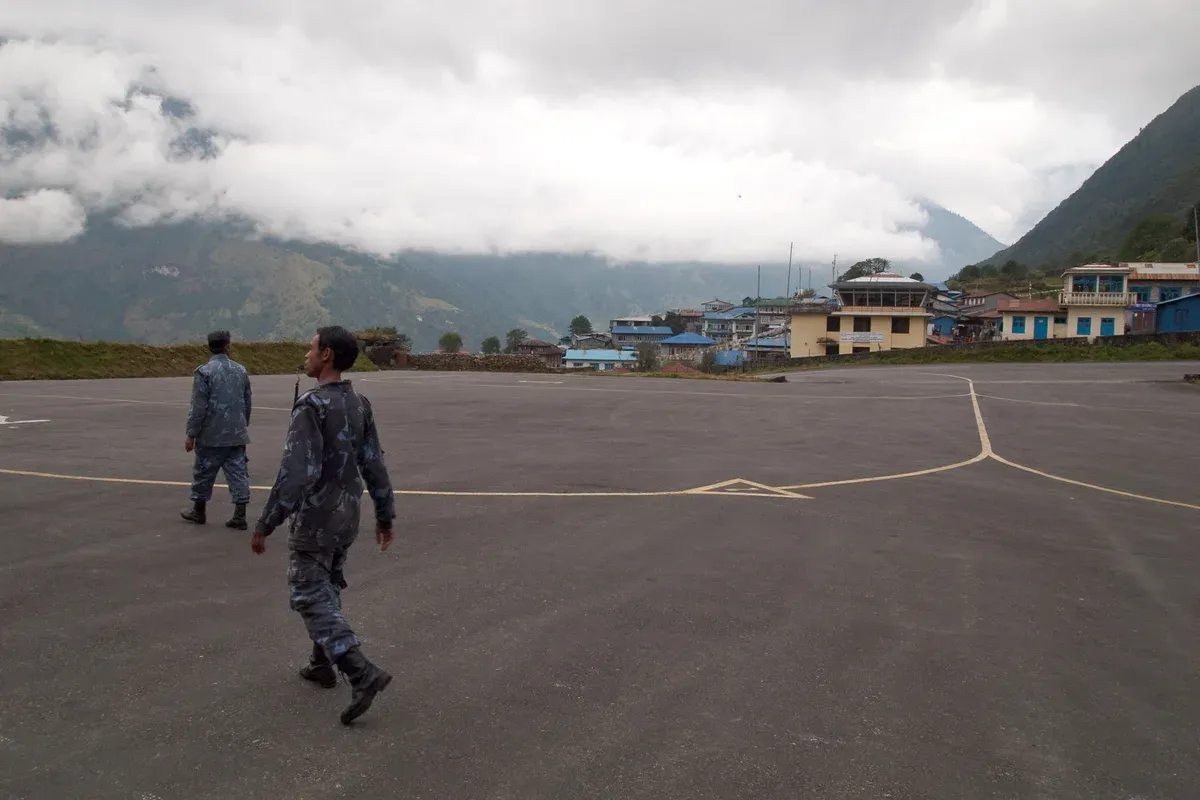
Tenzing-Hillary Airport in Lukla. Photo: Vyacheslav Argenberg, CC BY 4.0, via Wikimedia Commons
Quick answer Lukla airport in brief
Lukla airport is a 527 m (1,729 ft) uphill runway at 2,846 m (9,337 ft) with an 11.7% gradient, served only by helicopters and small STOL aircraft. Flights from Kathmandu take about 35 minutes, and in peak season most depart from Manthali in Ramechhap instead, after a 4 to 5 hour drive. Visibility closes the airport roughly half the time in monsoon, so treks build in spare days. Operator quotes for the one-way fare run from $150 to $215 depending on the source.
Key takeaways
- The Everest Base Camp Trek Lodge to Lodge includes round-trip Lukla flights via Ramechhap with transfers, permits and full board for $1,475 per person.
- Compare every base camp option in the base camp trek comparison on the homepage.
- Want to skip the small plane altogether? See the Everest Base Camp Helicopter Landing at $1,600 per person, which flies the whole route by helicopter.
- Plan the walk from the airstrip with the Everest Base Camp trek guide.
The Runway and Why It Is Famous
Lukla airport is famous for one of the shortest and steepest paved runways anywhere, cut into a Himalayan hillside at high altitude.
Runway Facts and Figures
Tenzing-Hillary Airport sits on a shelf above the Dudh Koshi valley in the Solukhumbu district. The strip runs uphill, which helps planes stop on landing and gives them a slope for takeoff. There is no radar, and landings rely on radio communication. Because the airport has no instrument landing system, pilots need clear visibility. Only helicopters and small STOL aircraft such as the DHC-6 Twin Otter, Dornier 228 and Let L-410 Turbolet can use it. The figures below come from Wikipedia and named operator sources.
Source heights differ slightly: the airport infobox lists 2,846 m (9,337 ft) and the article text 2,845 m, while the Lukla town article gives 2,860 m (9,380 ft) for the village and 2,786 m (9,140 ft) for the airport weather station.
| Fact | Figure | Source |
|---|---|---|
| Runway length and width | 527 m (1,729 ft) by 30 m (98 ft) | Wikipedia |
| Gradient | 11.7% | Wikipedia |
| Airport height | 2,846 m (9,337 ft), also given as 2,845 m in text | Wikipedia |
| Runway paved | 2001, designated 06/24 | Wikipedia |
| Renamed Tenzing-Hillary Airport | January 2008 | Wikipedia Edmund Hillary and airport articles |
| Pilot minimums | 100 STOL missions, one year of Nepal STOL experience, 10 instructor-supervised Lukla flights | Wikipedia |
History and the Safety Record
Sir Edmund Hillary bought the land for the airstrip from local Sherpas for $2,650 and involved them in building it in 1964. After Hillary and Tenzing Norgay promoted its construction, the airport was renamed after both men in 2008. Passenger numbers grew from 70,959 in 2003 to 146,879 in 2017, with 129,508 in 2019.
The safety record is real and should shape your plans, not scare you off. A 2010 History Channel programme, Most Extreme Airports, rated Lukla the most dangerous airport in the world. The main accidents are dated and documented. On 8 October 2008 Yeti Airlines Flight 101, a Twin Otter, crashed on final approach in fog, killing 18 of 19 aboard. Locals commemorate the victims each year and a memorial plaque stands near the site. On 28 September 2012 Sita Air Flight 601, a Dornier 228 bound for Lukla, crashed just after takeoff from Kathmandu, killing all 19 aboard, with payload above maximum takeoff weight named as the cause. On 27 May 2017 a Summit Air Let L-410 freight flight hit a tree short of the runway, killing both pilots. On 14 April 2019 a Summit Air Let L-410 with no passengers left the runway on takeoff and hit a helicopter, causing 3 deaths and 4 injuries. Sita Air also had a Dornier 228 crash-land at Lukla on 30 September 2004. The practical takeaway is simple: fly early in the day, in the main seasons, with an operator that includes flights in a tested itinerary such as the Everest Base Camp Trek Lodge to Lodge.
Sources: Wikipedia, Mount Everest, Wikipedia, Sagarmatha National Park
Flights from Kathmandu and Ramechhap
Scheduled flights connect Lukla with Kathmandu and, in peak season, with Manthali airport in Ramechhap, which most trekkers now use.
Airlines, Aircraft and Flight Times
Wikipedia lists Sita Air, Summit Air and Tara Air as the scheduled operators between Lukla, Kathmandu and Manthali, with Air Dynasty running helicopters from a Lukla hub. Tara Air was formed in 2009 when Yeti Airlines split off its STOL operations and runs daily scheduled flights. Planes seat 16 to 19 passengers with no assigned seats, so boarding is first come inside your flight. In trekking season the schedule can reach 30 departures a day between Lukla and Kathmandu, and the Nepali Times reported 11 departures a day to and from Lukla from Manthali plus 334 Manthali-Lukla flights in one October.
Flight times vary slightly by source. Himalayan Wonders gives 35 minutes from Kathmandu and 12 minutes from Ramechhap, while Best Heritage Tour gives 15 to 20 minutes from Manthali.
The Ramechhap Diversion in Peak Season
In the spring and autumn peaks, most Lukla flights moved from Kathmandu to Manthali Airport in Ramechhap because the volume of domestic traffic caused bottlenecks on Kathmandu's single runway. Best Heritage Tour says the flights run in March to May and September to November. The Bucket List Company dates the move to 1 October 2022 after a closure first imposed in 2019, while Ace the Himalaya says Manthali to Lukla operations began in March 2019.
The drive is the painful part. Sources disagree mildly on distance and time: Himalayan Wonders says 140 km and about 5 hours, The Bucket List Company says 130 km and 4 to 5 hours, and Best Heritage Tour says about 132 km and roughly 4 to 5 hours. Guests usually leave their Kathmandu hotel around 2 or 3 am to make the morning slots, and Manthali flights may start as early as 6:00 am. On the way back the drive can take 5 to 8 hours. Book a trip such as the Everest Base Camp Trek Lodge to Lodge and its listing includes the Ramechhap transfers for you.
Fares and Baggage Limits
Operator quotes for the Kathmandu to Lukla fare conflict, so check current prices when you book. The table gathers what named sources charge or quote. Only the card prices on our tour pages are bookable trip prices through this site.
For baggage, Best Heritage Tour puts the limit at 15 kg total: 10 kg checked in a soft duffel and 5 kg hand carry. Excess baggage is quoted at $5 to $8 per extra kg by Best Heritage Tour.
- Figures are as quoted by the named sources.
| Cost item | Figure | Source |
|---|---|---|
| Kathmandu-Lukla one-way fare | $215 each way | The Longest Way Home |
| Kathmandu-Lukla one-way fare | $150 one way | Himalayan Wonders |
| Shared helicopter seat to Lukla | $400 to $600 | Best Heritage Tour |
| Private helicopter from Kathmandu | $3,500 one way, up to 5 seats | Ace the Himalaya |
| Private helicopter from Manthali | $3,000 one way | Ace the Himalaya |
| Helicopter to avoid Ramechhap | about $600 one way with $150 of the flight fare refunded | Himalayan Wonders |
Fares are operator quotes, not bookings.
Lukla Landing - Cockpit View
The approach and landing at Lukla from the cockpit. Third-party video by Jimbo Burgess. This site did not shoot it and has no relationship with the creator.
Weather Holds and the Spare Day
Weather, not scheduling, is what strands trekkers at Lukla. Build slack into your plan and know the alternatives.
The Morning Flying Window
Strong southwest winds usually close Lukla from mid to late morning, so flights are scheduled early. Best Heritage Tour says visibility often drops by 11:00 am and recommends taking the first or second flight. Ace the Himalaya adds the visibility numbers: fixed-wing aircraft such as Twin Otters and Dorniers need 16,400 ft of visibility, while helicopters need only 4,900 ft, which is why helicopters fly on days planes cannot.
October is the most reliable month, with Everest Trekking Routes reporting about 1 in 10 departures delayed more than 2 hours.
Monsoon Cancellations and What Treks Do
During the June to August monsoon, visibility closes the airport about 50% of the time and cancels about half of all flights, and Everest Trekking Routes puts monsoon cancellation rates above 60%. The trekking seasons of March to May and September to November are therefore when almost everyone flies. Because delays can run to days, Ace the Himalaya advises adding at least one or two extra days to the itinerary, and guided treks build spare days into their schedules.
The classic routes, times and acclimatisation days are covered in the Everest Base Camp trek guide, and seasonal detail sits in the seasons section of the homepage.
The Helicopter Alternative
Helicopters are the escape hatch in both directions. Ace the Himalaya lists charter operators as Air Dynasty, Heli Everest, Kailash Helicopter Services, Altitude Air, Simrik Air and Fishtail Air. A private charter costs $3,500 one way from Kathmandu or $3,000 from Manthali per Ace the Himalaya, while Himalayan Wonders quotes about $600 one way with a $150 fare refund, and The Bucket List Company quotes $2,500 to $3,000 for up to 5 passengers.
Shared seats run about $400 to $600 per Best Heritage Tour. Coming out of the mountains, Wikipedia says a helicopter from Gorak Shep takes about 25 minutes to Lukla and about 90 minutes to Kathmandu. Some treks fold the helicopter into the itinerary itself, such as the EBC Trek with Helicopter Return at $2,250 per person.
For a pure flight day, the Everest Base Camp Helicopter Landing at $1,600 per person and the Everest View Hotel Helicopter Breakfast both fly the Kathmandu to Lukla routing as part of a longer loop.
Dos and Don'ts at Lukla Airport
Do
- Do take the first or second flight of the day, because visibility often drops by 11:00 am and southwest winds close the airport from mid to late morning.
- Do pack within 15 kg total, 10 kg checked and 5 kg hand carry, because that is the stated limit and excess fees apply per extra kg.
- Do add one or two spare days to your itinerary, because weather cancels roughly half of flights in monsoon and even October delays about 1 in 10 departures by more than 2 hours.
- Do use a soft duffel for checked luggage, because the 10 kg checked allowance is specified as a soft duffel bag.
- Do book a package that includes the flights and Ramechhap transfers if you want the logistics handled, because the 2 or 3 am hotel departure for a 4 to 5 hour drive is hard to arrange independently.
Don't
- Don't plan a tight international connection on your return day, because return road transfers from Ramechhap can take 5 to 8 hours and weather holds can add days.
- Don't count on an afternoon departure, because the morning window is when the airport operates.
- Don't trek in June to August expecting reliable flights, because visibility closes the airport about half the time and cancellations exceed 60% by one operator's count.
- Don't assume your fare, because operator quotes for the same one-way flight range from $150 to $215 and only confirmed booking prices are reliable.
Where to Stay Around the Lukla Flight
Each link opens the live room list for that place on the booking site, with today's prices. A night close to the departure point helps on an early flight.
Lukla
- Suits
- A lodge next to the runway for the first or last night of the trek
Flights run early in the day, so a night in Lukla before the flight out keeps you close to the runway.
See stays in LuklaThamel, Kathmandu
- Suits
- Hotels for the nights before and after the flight from Kathmandu
Most Everest trips in the catalog start and end in Kathmandu.
See stays in Thamel, KathmanduManthali, Ramechhap
- Suits
- A night near Ramechhap airport when the flights are moved there
In peak months the Lukla flights often leave from Ramechhap, a drive of several hours from Kathmandu.
See stays in Manthali, RamechhapLukla Airport FAQ
Why is Lukla Airport famous?
It is famous for a 527 m (1,729 ft) runway with an 11.7% gradient on a mountainside shelf at 2,846 m (9,337 ft), and a 2010 History Channel programme rated it the most dangerous airport in the world. It is also the gateway for the Everest Base Camp trek.
Is Lukla Airport dangerous to fly into?
It is demanding but tightly regulated. Pilots need at least 100 STOL missions, a year of Nepal STOL experience and ten supervised Lukla flights. Dated accidents from 2004 to 2019 are documented on this page, and the main defence is flying early in the day in season, as guided trips that include the flights do.
How much does it cost to fly to Lukla?
Operator quotes for the one-way Kathmandu flight run from $150 (Himalayan Wonders) to $215 (The Longest Way Home). Helicopter seats cost more, from about $400 to $600 shared per Best Heritage Tour. Many treks include the flights, such as the Everest Base Camp 12 Days trip at $955 per person.
Why do flights leave from Ramechhap instead of Kathmandu?
In peak season the volume of domestic flights caused bottlenecks on Kathmandu's single runway, so Lukla flights moved to Manthali Airport in Ramechhap. That adds a roughly 4 to 5 hour, 130 to 140 km drive from Kathmandu and a hotel departure around 2 or 3 am.
What is the baggage limit on the Lukla flight?
Best Heritage Tour states 15 kg total: 10 kg checked in a soft duffel and 5 kg hand carry. Excess baggage is quoted at $5 to $8 per extra kg by Best Heritage Tour.
What happens if my Lukla flight is cancelled?
You wait for the next weather window, which is why operators advise adding one or two spare days. The fallback is a helicopter, which needs only 4,900 ft of visibility against 16,400 ft for fixed-wing aircraft, and some itineraries such as the EBC Trek with Helicopter Return build the helicopter in from the start.