 Everest Climbing Tours
Everest Expedition: The 60-Day South Side Climb from Kathmandu
This Everest expedition listing from Monterosa Treks and Expedition is the only one on this site that goes for the summit of Mount Everest itself, at 8,848 m. It is sold on Viator at $42,000 per person and runs 60 days from arrival in Kathmandu to final departure, with about 45 days of that on the mountain. Each climber gets a dedicated climbing Sherpa guide, 6 bottles of oxygen with mask and regulator, the Everest climbing permit and a personal tent at base camp. For context, one industry source puts the median price for a Nepalese guide service on the Nepal side at $45,250. This page sets out what the price covers, what you pay on top, the route day by day and who should book a shorter climb instead. Compare it with the other Everest climbing tours.
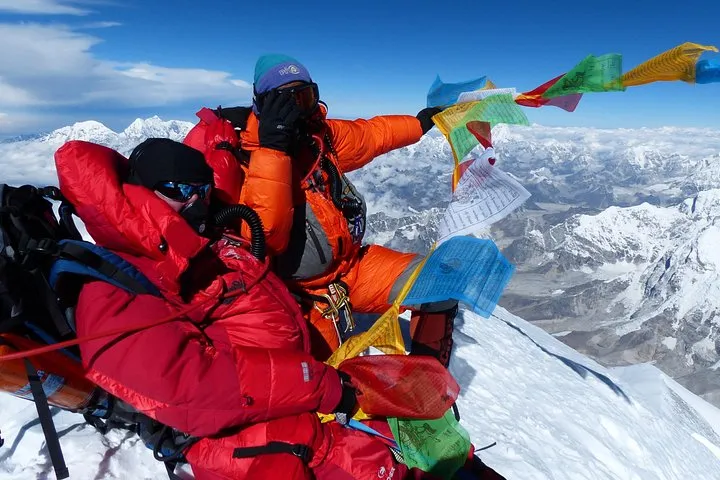
About This Tour
Monterosa Treks and Expedition runs this guided climb of Mount Everest from the Nepal side, the technically easier and more frequently used of the two main routes. The listing runs 60 days from arrival in Kathmandu to final departure. Days 1 to 10 cover preparation, a department briefing, the flight to Lukla and the lodge trek to base camp. Days 11 to 55 are the climbing phase, with rotations up the mountain and the summit push, then the trek back out to Lukla and the flight home.
Each climber has a 1 to 1 climbing Sherpa guide who is an Everest summiteer, 6 bottles of 20-litre oxygen with mask and regulator, and a north face style tent at base camp with dining, shower, store and toilet tents shared. The listing holds a 5.0 rating from 7 verified reviews on Viator and Tripadvisor. Weather and altitude decide whether a summit happens, and no listing can promise one.
$42,000 per person, covering the climbing permit, oxygen, base camp tents, lodges, the Lukla flight and a 1 to 1 climbing Sherpa
60 days, with about 45 days on the mountain from day 11 to day 55
Starts in Kathmandu with airport pickup, returns to Kathmandu
Mount Everest summit, 8,848 m
The Kathmandu to Lukla flight and back is included with 50 kg of cargo per climber, but lunch and dinner in Kathmandu, personal climbing gear, insurance, helicopter evacuation, a USD 1,800 guide summit bonus, USD 200 base camp staff tips and any helicopter charter are not
Full refund if you cancel at least 24 hours before departure
Check Dates and Availability
Departure times and dates appear once you check availability on the listing. Group size runs up to 15 travelers per booking.
You'll confirm the exact date and time on the secure booking page.
Quick answer Everest expedition at a glance
This guided Everest expedition costs $42,000 per person and runs 60 days from Kathmandu toward the 8,848 m summit of Mount Everest on the south side.
Key takeaways
- A 1 to 1 climbing Sherpa guide, 6 bottles of oxygen, the climbing permit and base camp tents are in the price, but see exactly what the price covers.
- Budget extra for the USD 1,800 guide summit bonus, USD 200 base camp staff tips, insurance and personal gear, listed under who the trip rules out.
- If a 60-day climb is too much, Island Peak Climbing is a first 6,000 m summit for $1,250.
- See how this listing compares with every other trip on Everest climbing tours.
What the Price Actually Covers
The $42,000 covers a lot, but not everything. The table below follows the operator's own included and excluded lists.
What Is in the Price
The listing includes the Everest climbing permit for the south side to the top, plus the icefall charge, fixed rope and main rope. Each member gets 6 bottles of 20-litre oxygen with mask and regulator. Accommodation is 4 nights in a 5-star Kathmandu hotel with breakfast, lodges from Lukla through Namche Bazaar to base camp on a full board basis, then a personal north face style tent at Everest base camp.
Above base camp you get climbing food with cooking pot, gas and stove. The Kathmandu to Lukla flight and back carries 50 kg of cargo per climber.
| Line | In the price | Notes |
|---|---|---|
| Everest climbing permit | Yes | South side to the top, plus icefall charge, fixed rope and main rope |
| Oxygen | Yes | 6 bottles of 20 litres per member with mask and regulator |
| Sherpa guide | Yes | 1 climber to 1 climbing Sherpa guide, an Everest summiteer |
| Kathmandu hotel | Yes | 4 nights, 5 star, breakfast only |
| Lodge trek | Yes | Full board from Lukla and Namche to base camp |
| Base camp tent | Yes | 1 north face style tent per climber, plus dining, shower, store and toilet tents |
| High-altitude food | Yes | Climbing food, cooking pot, gas and stove above base camp |
| Lukla flights | Yes | Kathmandu to Lukla and back, 50 kg cargo per climber |
| Lunch and dinner in Kathmandu | No | Pay these yourself |
| Insurance and evacuation | No | Life and medical insurance and helicopter evacuation are not included |
| Summit bonus and tips | No | USD 1,800 guide summit bonus and USD 200 per climber in base camp staff tips |
| Personal gear and charters | No | Personal climbing gear and helicopter charters if required |
What You Pay on Top
Nothing is marked as a mandatory extra by the booking platform, but two excluded amounts are expected in practice. Set aside the USD 1,800 guide summit bonus and USD 200 per climber in base camp staff tips. You also buy your own lunch and dinner in Kathmandu, your personal climbing gear, and life and medical insurance that covers helicopter evacuation.
Helicopter charters, if you need one, are billed separately. For background on the full cost picture, read how much it costs to climb Everest and the comparison of Everest climbing tours on the homepage.
Sources: Wikipedia, Mount Everest, Wikipedia, Sagarmatha National Park
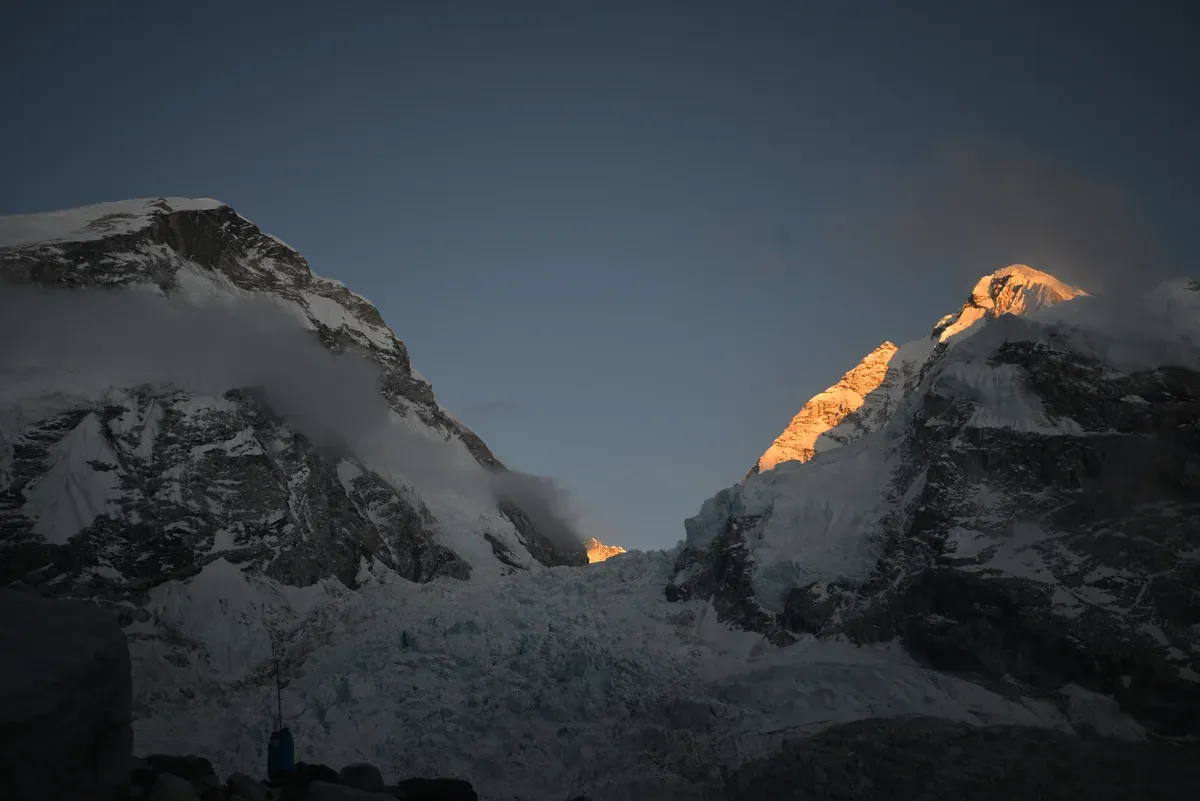
The Khumbu Icefall from base camp, with the west shoulder of Everest, Lhotse and Nuptse above. Photo: Thaneswar Guragai, CC BY-SA 4.0, via Wikimedia Commons
The Route Day by Day
The listing prints its own day-by-day itinerary, from arrival in Kathmandu to the final departure on day 60. The climbing phase runs from day 11 to day 55.
Kathmandu, the Trek in and the Climb
Days 1 to 3 are arrival, preparation and a briefing in the tourism department. Day 4 flies to Lukla and treks to Phakding. The trail then climbs through Namche Bazaar at 3,440 m with a day-hike acclimatisation day, on to Tengboche at 3,800 m, Pheriche at 4,243 m and Lobuche at 4,930 m, reaching Everest base camp on day 10, which the listing gives as 5,360 m.
Days 11 to 55 are the climbing window on Everest itself, which the operator uses for acclimatisation rotations and the summit push in a weather window. No camp heights on the mountain are printed in the listing. The walk out runs from day 56 to day 58, the flight back is on day 59 and day 60 is the airport transfer.
| Day | Route | Height |
|---|---|---|
| 1-3 | Kathmandu, preparation, department briefing | not stated |
| 4 | Fly to Lukla, trek to Phakding | not stated |
| 5 | Phakding to Namche Bazaar | 3,440 m |
| 6 | Acclimatisation day hike from Namche | not stated |
| 7 | Namche Bazaar to Tengboche | 3,800 m |
| 8 | Tengboche to Pheriche | 4,243 m |
| 9 | Pheriche to Lobuche | 4,930 m |
| 10 | Lobuche to Everest base camp | 5,360 m |
| 11-55 | Climbing Everest, rotations and summit push | 8,848 m summit |
| 56-58 | Base camp to Pheriche, Namche Bazaar, Lukla | 2,800 m at Lukla |
| 59-60 | Fly to Kathmandu, final departure | not stated |
Spare Days and the Summit Window
The listing does not name fixed spare weather days. Instead it blocks 45 days for the climbing phase, which is how traditional expeditions absorb bad weather. Industry sources describe standard South Col expeditions at around 51 days plus weather days, so this window is in line with the norm.
The summit push goes ahead in a weather window. No operator can promise a summit date or a summit at all, and you should read a weather delay as part of the plan rather than a failure.
Behind The First Summit of The World's Tallest Mountain
The story of the 1953 first ascent. Third-party video by National Geographic. This site did not shoot it and has no relationship with the creator.
Who This Trip Rules Out
A 60-day climb of an 8,000 m peak is not for everyone, and the listing says so plainly.
Fitness, Health and Age
The booking requires a high level of physical fitness, and the age band is 18 to 75. The operator does not recommend it for travelers with spinal injuries, poor cardiovascular health or pregnancy. There is no lower experience threshold stated in the listing, but a first-time climber should not read that as approval.
Nepali lawmakers have proposed requiring a summit above 7,000 m before an Everest permit is issued, though that rule is still a bill and not law. If you need a stepping stone, Island Peak Climbing is a 14-day first 6,000 m summit at $1,250, and the Three Peaks Climbing Trip stacks three summits over 30 days for $7,773.
Money, Weather and Bookings
The $42,000 leaves out insurance, helicopter evacuation, personal gear, lunch and dinner in Kathmandu, the USD 1,800 summit bonus and USD 200 in tips, so budget for all of it. Cancellation is free up to 24 hours before departure, which is generous for an expedition but check the platform terms yourself. Lukla flights are weather dependent, and visibility closes the airport about half the time in the monsoon, so delays at either end of the trip are normal.
If 60 days is simply too long, the Island Peak and EBC Climb gives you a summit climb and base camp in 20 days for $2,899, and the Everest Base Camp Trek 14 Days skips the climbing entirely.
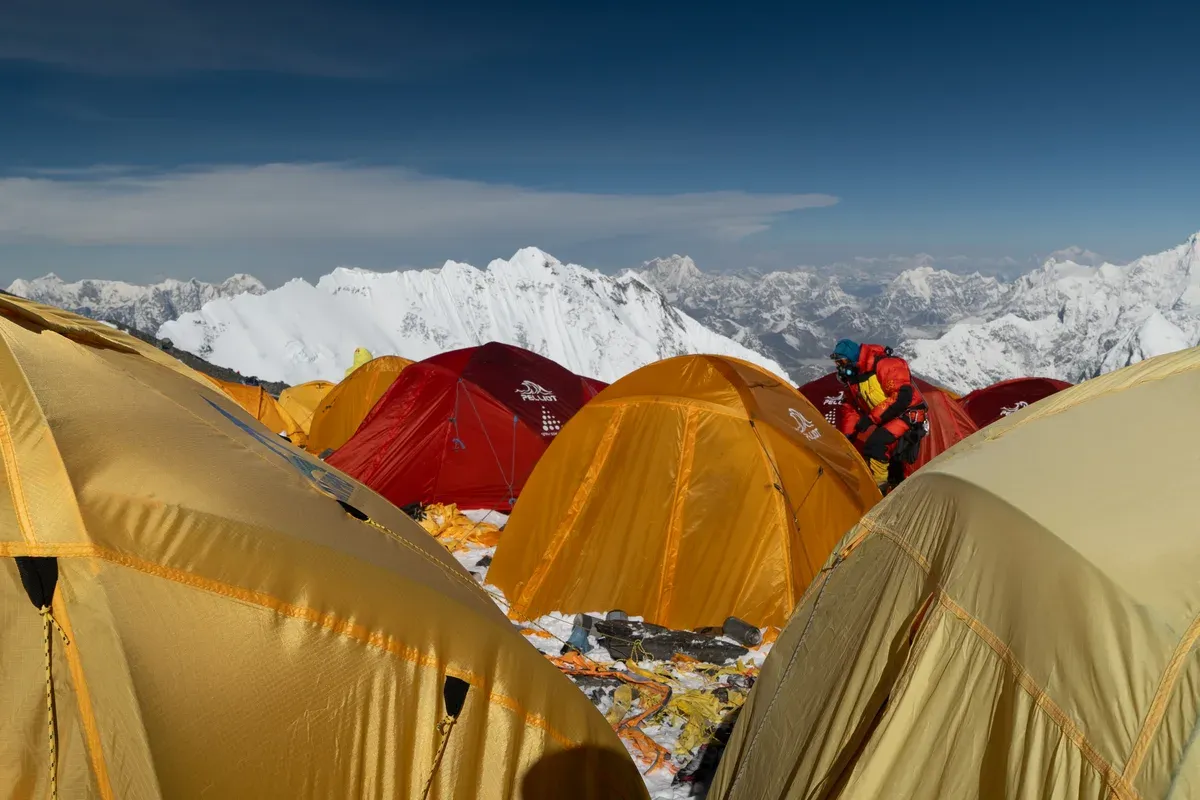
Camp IV on the South Col, about 7,900 m by the photographer's caption. Photo: AngeliSherpa, CC BY-SA 4.0, via Wikimedia Commons
Altitude, Season and Paperwork
Everything here comes from published guides and reference sources, not from the operator.
Season and Altitude
The Everest region has a spring season from March to May and an autumn season from September to November, and expeditions climb in spring. Base camp nights run about -17C in March, -12C in April and -8C in May on one operator's figures. Altitude sickness typically occurs above 2,500 m and symptoms often appear within ten hours of ascent.
The standard advice is to limit sleeping-altitude gain to about 300-500 m per day above 3,000 m, use climb high sleep low, and allow roughly one acclimatisation day for every 1,000 m gained. This itinerary has an acclimatisation day at Namche before the 45 climbing days. Read more in the guide to climbing Mount Everest and the page on Everest Base Camp.
Lukla Flights and Permits
The Kathmandu to Lukla flight takes about 35 minutes into Tenzing-Hillary Airport, a 527 m runway with an 11.7% gradient. Strong southwest winds usually close the airport from mid to late morning, so flights run early and delays are common. The Everest Southeast Ridge royalty for a foreign climber is $15,000 in spring, up from $11,000, a fee the operator's permit covers within this package.
The listing's permit also includes the icefall charge, fixed rope and main rope. For the trekking permits that apply on the walk in, see the Everest Base Camp trek guide and the page on Lukla airport.
Visa and Insurance
Nepal's tourist visa on arrival at Tribhuvan International Airport is 30 USD for 15 days, 50 USD for 30 days and 125 USD for 90 days, and it can be extended up to 120 days within a visa year. A 60-day trip is longer than the 30-day option. Buy life and medical insurance that covers Everest climbing and helicopter evacuation, because helicopter evacuation above 5,000 m is quoted at $6,000 to $10,000 or more by one guide and this listing excludes it.
Confirm the coverage explicitly with the insurer before you fly.
The 60 Days in Phases
The listing prints dated itinerary days. The phases below follow its own day numbers.
-
Days 1-3
Arrival and briefing
Airport pickup in Kathmandu with a sign at arrivals, then expedition preparation and a briefing in the tourism department. Four nights in a 5-star hotel with breakfast.
-
Days 4-10
Trek to base camp
Fly to Lukla and trek via Phakding, Namche Bazaar at 3,440 m with an acclimatisation day, Tengboche at 3,800 m, Pheriche at 4,243 m and Lobuche at 4,930 m to Everest base camp (5,360 m on the listing's figures), staying in lodges.
-
Days 11-55
Climbing Everest
About 45 days on the mountain. Rotations through the camps for acclimatisation, then the summit push toward 8,848 m in a weather window, with 6 bottles of oxygen per member and a 1 to 1 climbing Sherpa.
-
Days 56-58
Trek out
Base camp to Pheriche by lodge, then Pheriche to Namche Bazaar and Namche to Lukla (2,800 m on the listing).
-
Days 59-60
Return
Fly Lukla to Kathmandu, transfer to the hotel, then the airport for final departure.
What Weighs For and Against
An honest read of this listing against the market.
What we genuinely like
- A 1 to 1 climbing Sherpa guide who is an Everest summiteer
- 6 bottles of 20-litre oxygen per member with mask and regulator included
- The climbing permit, icefall charge, fixed rope and main rope are in the price
- Kathmandu to Lukla flights both ways with 50 kg of cargo per climber
- A personal north face style tent at base camp, plus shower and toilet tents
- At $42,000 it sits below the $45,250 median for a Nepalese guide service cited by one industry source
The honest downsides
- Excludes insurance, helicopter evacuation and personal climbing gear, which for Everest means serious money
- Add a USD 1,800 guide summit bonus and USD 200 per climber in staff tips on top
- Only 7 reviews back the 5.0 rating, so the track record is thin compared with treks carrying thousands
- 60 days is a long absence, and Lukla flight delays can stretch it further
- No summit is guaranteed, weather and altitude decide
Who it's NOT for: Anyone who wants a shorter or cheaper Everest region trip should look at a trekking peak or a base camp trek instead.
Everest Expedition Questions
How much does this Everest expedition cost and what is not included?
The listing is $42,000 per person for 60 days. Not included are lunch and dinner in Kathmandu, personal climbing gear, life and medical insurance, helicopter evacuation, a USD 1,800 guide summit bonus, USD 200 per climber in base camp staff tips and helicopter charters. See how that compares on the homepage of Everest climbing tours.
How long does the Everest expedition take?
The itinerary runs 60 days from arrival in Kathmandu to final departure, with about 45 days on the mountain from day 11 to day 55. Industry sources put a standard expedition at about two months, so it is a normal length. The Three Peaks Climbing Trip is a 30-day alternative.
Do I need previous high-altitude climbing experience?
The listing states a high level of physical fitness and an age band of 18 to 75, but names no prior summits. A 7,000 m prerequisite for Everest permits has been proposed in Nepal but is still a bill, not law. Build experience on Island Peak Climbing first.
What is the highest point on this trip?
The highest point is the Mount Everest summit at 8,848 m, reached from the south side if weather and conditions allow. Base camp sits at 5,360 m on the listing's figures. No operator can promise a summit.
Is insurance included in the price?
No, the listing excludes life and medical insurance and emergency evacuation by helicopter. Helicopter rescue above 5,000 m is reported to run $6,000 to $10,000 or more, so buy a policy that explicitly covers Everest climbing before departure.
What happens if the Lukla flight is cancelled?
The Kathmandu to Lukla flight is included in the price, but visibility closes Lukla airport about half the time during the monsoon and flights typically run early. Delays happen, so keep buffer days in your plans. More detail is on the Lukla airport page.
Can I cancel if my plans change?
Yes, cancel at least 24 hours before departure for a full refund under the platform's standard terms. Read the full cancellation terms on the booking page before you pay.
Prices, availability and terms are set by the operator and confirmed at checkout.
We may earn a commission if you book through one of our links, at no extra cost to you. Full affiliate disclosure