 Everest Climbing Tours
How Much Does It Cost to Climb Everest?
How much does it cost to climb Everest? Most climbers pay between $40,000 and $80,000, and some pay up to $300,000, according to Alan Arnette's cost research. This page breaks the total into its parts: the Nepal climbing permit and government fees, oxygen, Sherpa wages and summit bonuses, gear, insurance and flights. It compares Nepalese guide services, international operators with Sherpa guides and western-guided expeditions on both the Nepal and Tibet sides, using published medians and ranges with their sources named. It also lists the one full bookable expedition in the catalog at its card price and shows cheaper ways to get high on Everest, from trekking peaks to base camp. The bookable trips are compared on Everest climbing tours.
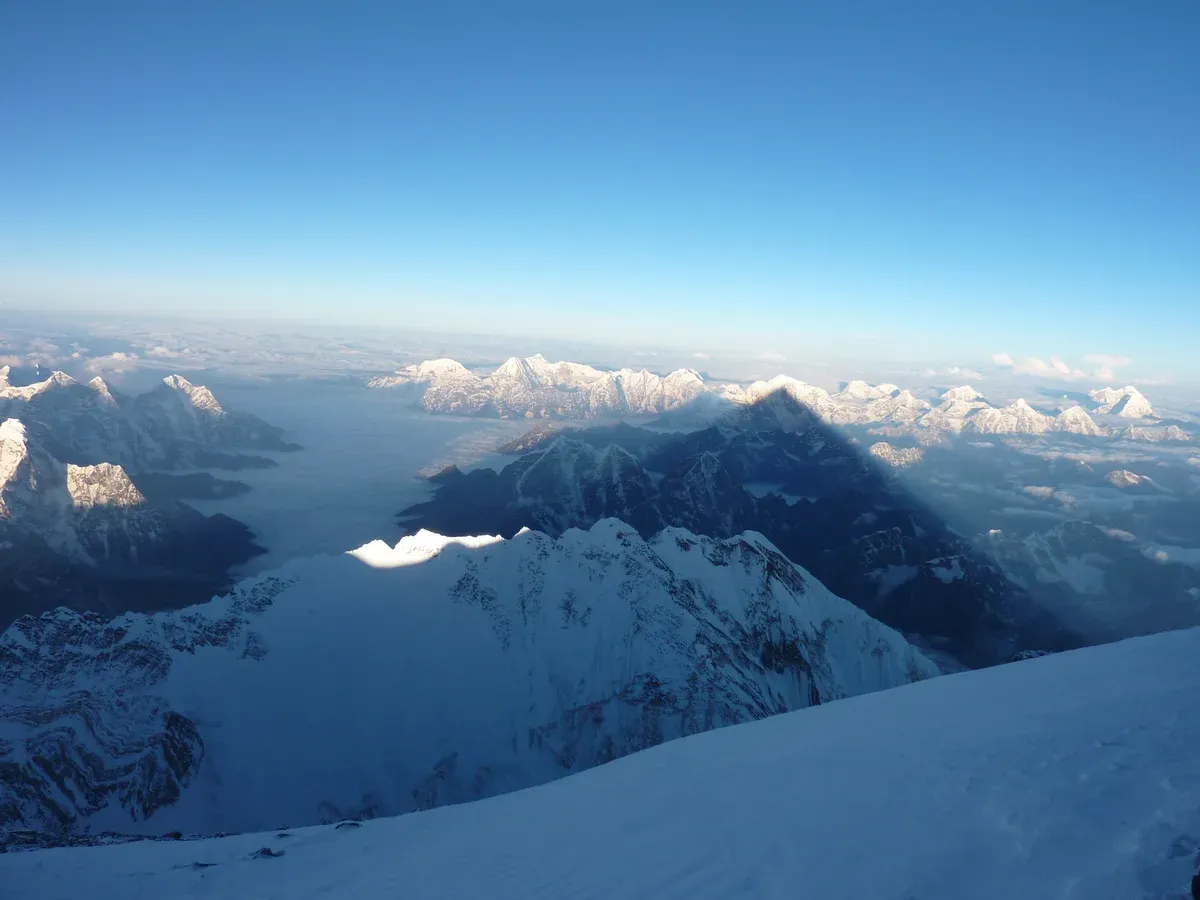
Sunrise from the summit of Everest toward Nuptse. Photo: Carlos Pauner, CC BY-SA 3.0, via Wikimedia Commons
Quick answer The cost in one answer
It costs most people between $40,000 and $80,000 to climb Everest, and some pay up to $300,000, per Alan Arnette's cost research. The Nepal spring royalty alone is now $15,000 per foreign climber on the normal route. The only full bookable expedition in the catalog is $42,000 per person.
Key takeaways
- The full south-side climb with permits, oxygen, Lukla flights and a climbing Sherpa is the Everest Expedition Nepal at $42,000 per person.
- Permits and fees now total close to $25,000 before guides, food or gear, per Alan Arnette. See the permit fee table below.
- Want the mountain experience without the price tag? The Island Peak and EBC Climb lists a top of 6,189 m for $2,899.
- Just getting there costs far less. Compare every option on Everest climbing tours or the base camp treks.
The Permit and Government Fees
The Everest climbing fee is the largest single line item and it rose sharply for the 2025 season onward.
Nepal Royalty and Deposits
Nepal charges a royalty per foreign climber, and it changed on 1 September. The spring fee on the Southeast Ridge normal route went from $11,000 to $15,000, a 36% increase per Advnture. Autumn rose from $5,500 to $7,500 and winter and summer monsoon from $2,750 to $3,750, as reported by the Kathmandu Post and Alan Arnette. Other Everest routes cost less: $10,000 spring, $5,000 autumn and $2,500 winter and summer per the same royalty table. On top of the royalty come an agency fee of $3,500 per team, a liaison officer at $5,000 per team and a trash deposit of $4,000 per permit, described by Alan Arnette as refundable but not always refunded.
Nepali climbers pay far less: NPR 150,000 in spring, NPR 75,000 in autumn and NPR 37,500 in winter and summer on the normal route, per Nepal Hiking's fee table. The royalty table for other routes gives the figures below.
| Fee | Amount | Notes |
|---|---|---|
| Everest normal route, foreign, spring | $15,000 (up from $11,000) | Effective 1 September, per Alan Arnette and Kathmandu Post |
| Everest normal route, foreign, autumn | $7,500 (up from $5,500) | Per Kathmandu Post |
| Everest normal route, foreign, winter and summer | $3,750 (up from $2,750) | Per Kathmandu Post |
| Everest other routes, foreign, spring | $10,000 | Autumn $5,000, winter and summer $2,500, per the royalty table |
| Everest normal route, Nepali, spring | NPR 150,000 | NPR 75,000 autumn, NPR 37,500 winter and summer, per Nepal Hiking |
| Agency fee | $3,500 per team | Per Alan Arnette's costs page |
| Liaison officer | $5,000 per team | Per Alan Arnette's costs page |
| Garbage deposit | $4,000 per permit | Refundable but not always refunded, per Alan Arnette |
| Tibet-side Chinese permit | $15,800 to $18,000 per person | Teams of four or more, covers transport, hotels, liaison officer, trash fee and yaks, per Alan Arnette |
| Tibet work permit per Nepali Sherpa | $4,500 | Plus a $5,000 salary, per Alan Arnette |
What Changed and the Bill Still in Parliament
Three changes now shape the price of an Everest expedition. The royalty rose across every season. The permit validity was cut from 75 days to 55 days, per Yatri Trekking and the Kathmandu Post. And Nepal requires one guide for every two climbers on peaks above 8,000 m, which raises staffing costs. Alan Arnette estimates the permit change alone adds $5,000 to $7,000 per person to an expedition.
More changes are proposed but not yet law. Nepal's Integrated Tourism Bill was registered on April 18, 2025. The upper house passed it, after which officials estimated at least three months before it could become law, per the Kathmandu Post. ETV Bharat later described it as still a bill, in final discussion in a House of Representatives committee with nearly 260 amendments proposed. The bill would require Everest applicants to have climbed a mountain over 7,000 m in Nepal, would require a health certificate issued within the previous month for every team member, and would turn the $4,000 refundable waste deposit into a non-refundable fee paid into a welfare fund. Explorersweb reported the 7,000 m rule would not take effect in the 2026 season and that a peak climbed outside Nepal would not count. Treat all of this as pending, not current law.
Sources: Alan Arnette, Kathmandu Post, Yatri Trekking
Where the Rest of the Money Goes
After the permit, the bill is built from oxygen, people and logistics. These figures come from Alan Arnette's cost guides and other named sources.
Line Items Beyond the Permit
Alan Arnette says you need almost $25,000 for permits and fees before hiring guides, yaks, food or gear. Oxygen is a major variable. His 2015 guide lists $550 per bottle with a minimum of 5 bottles, plus $450 for a mask and $450 for a regulator, while Global Summit Guide cites a 2026 benchmark of about $650 per bottle. Packages differ hugely: Wild Yak Expeditions includes 7 bottles of 4 L plus 3 reserves, Furtenbach's Classic includes 8 bottles and its Flash includes unlimited oxygen.
Sherpa pay and bonuses matter too. Marketplace reported in 2014 that Sherpas earn at least $2,000 per season, with elite Sherpas making $4,000 to $5,000 in about two months, and Wikipedia says up to $5,000 for a summit-guiding season. Hiring a personal Sherpa adds $5,000 to $10,000 plus 5% to 20% in tips and bonuses, per Alan Arnette. One company asks $1,500 when the Sherpa reaches the South Col and $500 on return from the summit. Tips and bonuses for Sherpas, cooks and others run $600 to $4,500+ per individual, and 10% is often the minimum with some operators suggesting 15% to 20%.
Gear and insurance are yours to fund. Himalayan Partner's author spent close to $8,000 to $10,000 on gear even after renting some items, and puts insurance at $500 to $2,500. Himalayan Hero recommends a minimum $100,000 evacuation limit, ideally $200,000 to $500,000 for high-altitude expeditions, since helicopter evacuation runs about $6,000 to $10,000+ above 5,000 m and $10,000 to $15,000+ from trekking peaks above 6,000 m.
| Item | Typical cost | Source |
|---|---|---|
| Oxygen bottle | $550 (2015 guide), about $650 (2026 benchmark) | Alan Arnette, Global Summit Guide |
| Mask and regulator | $450 each | Alan Arnette 2015 cost guide |
| Sherpa season pay | At least $2,000, elite $4,000-5,000, up to $5,000 | Marketplace (2014), Wikipedia |
| Personal Sherpa | $5,000 to $10,000 plus 5-20% tips and bonuses | Alan Arnette |
| Sherpa summit bonus example | $1,500 at South Col and $500 on return (one company) | Alan Arnette |
| Tips and bonuses overall | $600 to $4,500+ per individual, 10% minimum often | Alan Arnette |
| Personal gear | About $7,000 new (2015), $6,000 to $10,000 per Wild Yak, $8,000-10,000 per Himalayan Partner | Alan Arnette, Wild Yak Expeditions, Himalayan Partner |
| Insurance | $500 to $2,500, evacuation cover of $100,000 minimum | Himalayan Partner, Himalayan Hero |
| Kathmandu to Lukla flight | $325 round trip (2015) | Alan Arnette 2015 cost guide |
| International airfare | $1,500 to $5,000 (2015) | Alan Arnette 2015 cost guide |
| Food and fuel | About $1,000 per person over six weeks | Alan Arnette |
| Base camp cook and assistant | $6,000 now, $5,000 in the 2015 guide | Alan Arnette |
| Icefall Doctors | $2,500 per team or $600 per climber (2015) | Alan Arnette |
| Fixed rope and puja | $150 fixed rope, $300 puja (2015) | Alan Arnette |
Sources: Alan Arnette, Himalayan Hero
Mount Everest Budget vs Luxury: $30,000 vs $130,000 Expedition
How a budget expedition differs from a luxury one. Third-party video by Hoshi Summit. This site did not shoot it and has no relationship with the creator.
Budget, Mid-Range and Western-Guided
Who guides you and on which side of the mountain moves the price more than almost anything else.
Medians by Operator Type and Side
Alan Arnette's figures show a wide spread. On the Nepal side, the 2026 median is $45,250 for a Nepalese guide service, $54,000 for an international operator using a Sherpa guide and $76,000 for an international operator with an international guide. On the Tibet side the medians are $47,000 for Nepalese guide services and $90,800 for international operators with an international guide, up 22%. Over ten years, Nepalese guide medians went from $32,000 to $45,250 and international operators in Nepal from $59,000 to $76,000.
Other framings agree. Alan Arnette says most people pay $40,000 to $80,000 with some up to $300,000, Sherpa-supported non-guided climbs run $30,000 to $55,000 and fully guided climbs from $65,000 to over $125,000, with speed climbs at $100,000 or more. A solo climber from Nepal needs at least $41,000 and about $49,000 with Sherpa support, he writes. Global Summit Guide groups operators into tiers of $30K-$45K+, $45K-$65K+, $65K-$100K+ and $100K-$300K+, and cites a 2026 Nepal south side median published price of $54,995 with an average of $61,267. Himalayan Partner puts budget packages at $30,000 to $45,000 and premium trips above $100,000. Tibet Travel's FAQ says a climb costs around $40,000 or more. Advnture puts total prices at about $33,000 to $200,000.
What does more money buy? Higher-priced western operators typically offer international guides, a low client-to-guide ratio and more oxygen. Adventure Consultants, for example, advertises a 1:4 international guide ratio, 1:1 Sherpa on summit day and high flow oxygen from Camp 2, at US$83,000 ex Kathmandu over 52 days. Alpine Ascents lists its South Col expedition at $80,000 per person on a 5-climber team, with the permit and administration fees included but international airfare and a $1,500 Sherpa summit bonus not.
- Nepal side medians 2026: $45,250 Nepalese guide, $54,000 international with Sherpa guide, $76,000 international with international guide (Alan Arnette)
- Tibet side medians 2026: $47,000 Nepalese guide, $90,800 international with international guide (Alan Arnette)
- Sherpa-supported non-guided: $30,000 to $55,000 (Alan Arnette)
- Fully guided: $65,000 to over $125,000, speed climbs $100,000 or more (Alan Arnette)
Sources: Alan Arnette, Global Summit Guide
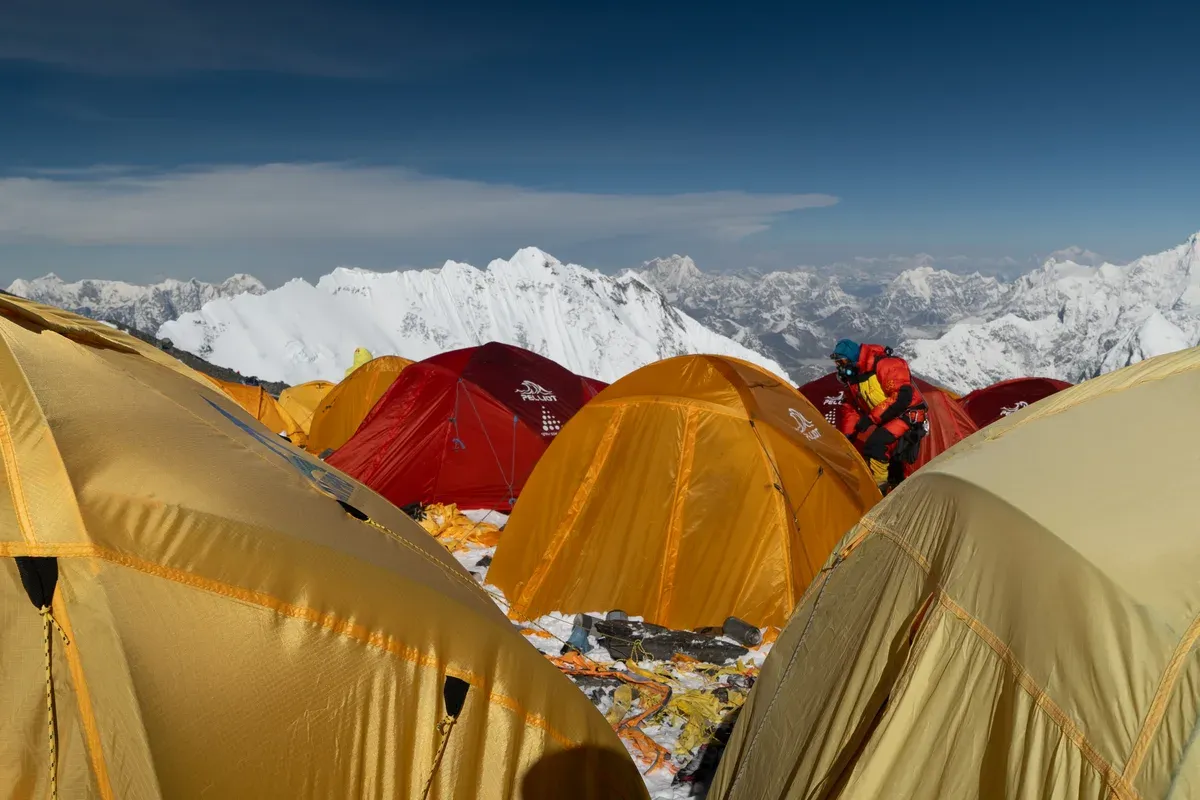
Camp IV on the South Col, about 7,900 m by the photographer's caption. Photo: AngeliSherpa, CC BY-SA 4.0, via Wikimedia Commons
The Bookable Expedition and Cheaper Ways to Climb
One full Everest expedition is bookable in the catalog, and several trekking peaks deliver high-altitude climbing for a fraction of the price.
The Full Expedition at Its Card Price
The Everest Expedition Nepal costs $42,000 per person and runs 60 days from Kathmandu, operated by Monterosa Treks and Expedition, with up to 15 per booking and an age band of 18 to 75. It targets the summit at 8,848 m from the south side with a climbing Sherpa for every climber. The listing includes the Kathmandu to Lukla flights and back with 50 kg of cargo per climber, the climbing permit for Everest plus the icefall charge, fixed rope and main rope, oxygen and base camp tents. Be clear about what it leaves out: a USD 1,800 guide summit bonus and USD 200 per climber in base camp staff tips are excluded, so budget for both. International flights to Nepal, personal gear and insurance are also yours to arrange. Against the published medians above, $42,000 sits below the $45,250 Nepalese guide median on the Nepal side. Cancellation is free up to 24 hours before the start.
No summit is guaranteed at any price. Altitude, weather and Lukla flight delays all decide outcomes. For what the route actually involves, see the guide to climbing Mount Everest.
Trekking Peaks as the Low-Cost Entry
Trekking peaks give high-altitude climbing for a fraction of the price, though all of them sit below 7,000 m, so none would meet the proposed 7,000 m rule. The Island Peak and EBC Climb costs $2,899 per person over 20 days, treks to Everest Base Camp at 5,364 m (17,598 ft) first, then climbs Island Peak, listed at 6,189 m (20,305 ft) while Wikipedia gives 6,165 m, with permits, lodges and a climbing Sherpa included and Lukla flights both ways. A shorter option is Island Peak Climbing at $1,250 per person over 14 days, though its listing puts the Island Peak permit, the Lukla flights at USD 500 per person and climbing guide insurance outside the price, so confirm with the operator before booking. For a higher summit, Mera Peak Climbing costs $3,000 per person over about 18 days with climbing permits, gear and 4 nights in Kathmandu included, and its listing does not state the summit height. The Three Peaks listing gives Mera as 6,476 m. The Three Peaks Climbing Trip links Mera at 6,476 m, Island Peak at 6,189 m and Lobuche Peak at 6,119 m over 30 days for $7,773 with permits, meals and internal flights included.
If even that is too much, the Everest Base Camp trek reaches base camp from $955 per person over 12 days. Costs for that trip are covered on its own page.
Dos and Don'ts for the Budget
Do
- Do budget for the summit bonus and tips separately, because operators often exclude them. Alpine Ascents excludes a $1,500 Sherpa summit bonus and the catalog expedition excludes USD 1,800 plus USD 200 in tips.
- Do buy insurance with a high evacuation limit before you pay any deposit, because Himalayan Hero recommends $100,000 minimum and $200,000 to $500,000 for expeditions, and evacuations from above 5,000 m run about $6,000 to $10,000+.
- Do check what each price includes, because Adventure Consultants includes government royalties while Wild Yak states its Nepal climbing permit of about USD 15,000 is on top of its price.
- Do carry proof of heli-rescue and medical insurance if you want to opt out of the NPR 8,500 guide insurance plus NPR 2,000 service fee, which the updated provisions allow.
- Do not treat a trekking peak as a way to meet the pending 7,000 m rule, because Island Peak and Mera Peak are both under 7,000 m and the bill is not yet law.
Don't
- Don't assume the $4,000 garbage deposit always comes back, because Alan Arnette describes it as refundable but not always refunded.
- Don't plan a Tibet-side climb around a published price list, because Alan Arnette notes China announces new rules only to selected operators and does not publish them, and Himal Press reported the Tibet side closed for spring 2026.
- Don't compare operator prices without checking oxygen counts, because packages range from Wild Yak's 7 bottles plus 3 reserves to Furtenbach's unlimited oxygen on its Flash trip.
- Don't count on extra time in the season, because permit validity was cut from 75 days to 55 days.
Cost Questions
How much does it cost to climb Everest in total?
Alan Arnette says most people pay between $40,000 and $80,000 and some pay up to $300,000, and the spring permit alone is $15,000. The bookable Everest Expedition Nepal sits at $42,000 per person.
What does the Everest climbing permit cost?
The Nepal royalty is $15,000 per foreign climber in spring on the normal route, $7,500 in autumn and $3,750 in winter and summer, plus a $4,000 garbage deposit. The full fee table is in the permit section above.
How much are Sherpas paid on Everest?
Marketplace reported at least $2,000 per season with elite Sherpas making $4,000 to $5,000, and Wikipedia says up to $5,000 for a summit-guiding season. On the client side, a personal Sherpa adds $5,000 to $10,000 plus 5% to 20% in tips, per Alan Arnette. Trip prices including Sherpa support are compared on the Everest climbing tours.
Why is Everest more expensive with western guides?
The 2026 median for an international operator with an international guide on the Nepal side is $76,000 against $45,250 for a Nepalese guide service, per Alan Arnette. Western operators typically offer international guides and a lower client-to-guide ratio. See the operator medians above.
Can you climb Everest for free or cheap?
No source describes a free Everest climb, and the permit alone is $15,000 in spring. The cheap route to real Himalayan climbing is a trekking peak such as Island Peak Climbing at $1,250 per person, though its Lukla flights and permit read as extra.
How much does insurance and evacuation cost?
Himalayan Partner puts insurance at $500 to $2,500, and Himalayan Hero says helicopter evacuation runs about $6,000 to $10,000+ above 5,000 m. Gear is a separate cost of roughly $6,000 to $10,000. Base camp treks need lower cover limits, as the Everest Base Camp trek guide explains.